My Crittercam
My Crittercam › Coyote

Backyard coyote mistaken for a wolf in the snow

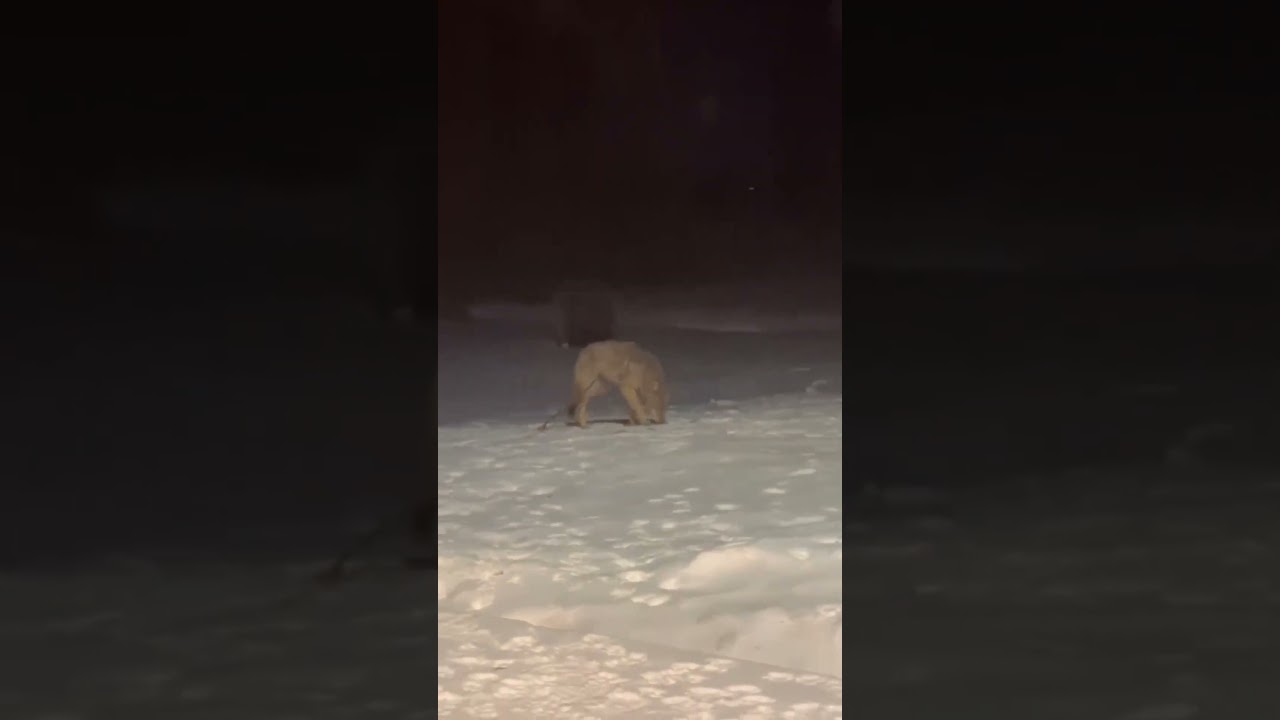
A tawny coyote stands with its head lowered to trampled, lit snow in a dark backyard at night.

Footage: The Pet Collective · 0:18 · uploaded March 27, 2024
Written by My Crittercam · published November 6, 2026

The Story

Head down, a tawny coyote works over the snow of a lit backyard at night, nosing the ground where the family dogs were just playing with it. The household took it for a wolf.

The evidence is brief: under twenty seconds of night footage, snow pocked with tracks across the yard, and one animal at the edge of the light. By the time the mistake sinks in, the dogs are back inside, growling as if they had seen through it all along. The coyote leaves with their toy pig.

The confusion is easy to settle. A coyote is about one-third the size of a gray wolf and slighter in build, with a longer, narrower muzzle than a dog. The coat runs from blonde to dark tan washed with black, and the legs, ears and cheeks are usually reddish. On the run, a coyote carries its tail down. A dog runs with its tail up, a wolf with its tail straight out.

Coyotes are essentially nocturnal, more active after sunset and at night, and a backyard is no stretch for a species that uses suburban and urban settings as well as forest and grassland. In snow, a coyote walks a meadow listening for small mammals moving underneath, then leaps and dives face first.

What this one meant by the romp is beyond what the footage can show. The figures on risk are plainer. Coyotes are less likely than wolves to form packs, hunting alone, in pairs or in family units, and in a Chicago-area study a third to a half of the coyotes followed each year were solitary. Cats and small to mid-size dogs left out unprotected at night may be killed; Chicago-area newspaper records count 70 attacks on dogs.

The fix is low-tech. Make noise, wave a stick, turn on the hose, and never offer food, so coyotes keep their natural fear of people.
Field Guide

In a snowy backyard at night, a coyote the family took for a wolf noses the ground where their dogs had been playing, then leaves with the dogs' toy. Full field guide for the Coyote

Common nameCoyote
Scientific nameCanis latrans
FamilyCanidae (Dogs, wolves, foxes and jackals)
SizeLength 75 to 100 cm; 16-20 inches high at the shoulder (Yellowstone); eastern coyote 4 to 5 feet nose to tailAnimal Diversity Web, University of Michigan · National Park Service · New York State Department of Environmental Conservation
Weight7 to 21 kg; 25-35 pounds in Yellowstone; eastern coyote 35 to 45 poundsAnimal Diversity Web, University of Michigan · National Park Service · New York State Department of Environmental Conservation
DietAbout 90% mammals: voles, mice, rabbits, squirrels, plus deer, carrion, birds, insects and fruitAnimal Diversity Web, University of Michigan · National Park Service · New York State Department of Environmental Conservation
Active whenEssentially nocturnal; more active after sunset and at night, but may be seen moving about during the dayAnimal Diversity Web, University of Michigan · New York State Department of Environmental Conservation
RangeAlaska and Canada south through the US and Mexico to Central America; expanded into the eastern USAnimal Diversity Web, University of Michigan · NatureServe Explorer
LifespanIn Yellowstone: average life span 6 years, up to 13 yearsNational Park Service
Conservation statusIUCN Red List: Least Concern; NatureServe: G5NatureServe Explorer
Cam notes · Time of daynight, artificially lit
Cam notes · Seasonwinter, snow on the ground
Cam notes · Placea backyard

Habitat

Behavior

Questions

Is that a coyote or a wolf?

A coyote is about one-third the size of a gray wolf, with a slighter build. Coyotes run with the tail down, while wolves hold it straight out.National Park Service · National Park Service

Will a coyote go after my dog?

Cats and small to mid-size dogs left outside at night in an unprotected area may be killed. Chicago-area newspaper records show 70 attacks on dogs, with small breeds attacked more often than larger ones.Washington Department of Fish and Wildlife · Urban Coyote Research Project (Cook County, Illinois)

Do coyotes travel in packs?

Coyotes are less likely to form packs than wolves and hunt alone, in pairs or in family units. In a Chicago-area study, one-third to one-half of the coyotes studied each year were solitary, travelling up to 60 square miles.Animal Diversity Web, University of Michigan · Urban Coyote Research Project (Cook County, Illinois)

Latest clips