My Crittercam
My Crittercam › American bison

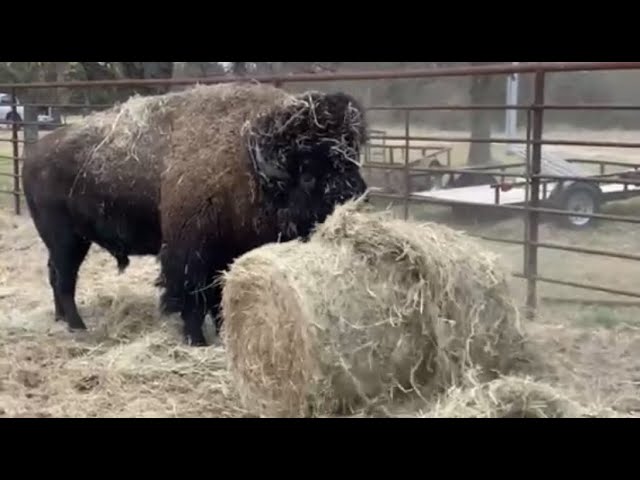
Big Joe the bison takes apart a round hay bale

A dark-headed American bison bull with strands of hay across his head and shoulders stands behind a large round hay bale, a pipe fence beyond him.

Footage: Cross Timbers Bison · 15:40 · uploaded November 29, 2020
Written by My Crittercam · published November 6, 2026

The Story

The tractor is still holding the round bale when Big Joe hits it. He is an American bison bull in a ranch holding pen, and the blow rattles the machine.

His rancher puts a bale like this at about a thousand pounds, the top weight for a Yellowstone cow, and Joe shoves it around like a ball. Within a couple of minutes it has burst open. He tears it down to about a third of its size, then rolls the rest around the pen until it knocks into the water trough. Somewhere along the way he has also put a hole in that trough.

The rancher missed all of it. His mother brought the hay out with his stepfather and filmed the show. He had rated his three-year-old bull the hard case with hay, and says he has never seen a bison wreck a bale like this.

Joe carries the hump of his kind over his front shoulders, a mass of shoulder and neck muscle that lets a bison swing its head side to side and clear snow from its foraging patches. Yellowstone bulls weigh up to 2,000 pounds.

A lot of that hay is wasted, and the rancher lets it go. Joe has spent two or three weeks in this pen with two cows, and a bale gives a bull somewhere to put his aggression. What remains makes a bed on a cold, wet day. The cows wanted to eat it.

Some of that aggression has an address. The three-year-old lives in a pen some 70 or 80 yards off, and when Joe starts up he paces his fence, making little strut sounds with his breathing. Bison communicate with grunts and snorts, and his owner reads it as a bull saying he is here. The rancher wants these two kept apart for good. If they locked up, he says, both bulls and his equipment could take serious damage, and the three-year-old could be badly hurt. So the fence stays, and the bale takes the hit.
Field Guide

Big Joe, an American bison bull, rattles a tractor by hitting the round bale it carries, then tears the bale down and rolls the rest around his pen. Full field guide for the American bison

Common nameAmerican bison
Scientific nameBison bison
FamilyBovidae (cattle, bison, antelope and goats)
SizeMature bulls can reach 5.5 to 6.5 ft (1.9 m) at the hump and 9 to 12.5 ft (2.7 to 3.8 m) long; cows are normally 5 ft (1.5 m) high and 7 to 10 ft (2.2 to 3.2 m) long.Smithsonian's National Zoo and Conservation Biology Institute
WeightBulls up to 2,000 pounds; cows up to 1,000 pounds (Yellowstone).National Park Service (Yellowstone National Park)
DietYellowstone bison: more than 90% grasses, sedges and other grass-like plants; forbs and browse usually under 5%.National Park Service (Yellowstone National Park)
Active whenPrimarily diurnal, especially early morning and late afternoon, with grazing periods between loafing and ruminating.NatureServe Explorer
RangeOnce Alaska to northern Mexico; now found on private and protected lands in areas of the western United States and Canada.Animal Diversity Web, University of Michigan
Lifespan15 to 20 years in the wild; up to 40 years recorded in captivity.Animal Diversity Web, University of Michigan
Conservation statusIUCN Red List: Near Threatened; NatureServe Global Rank G4. COSEWIC (Canada): Plains Bison Threatened, Wood Bison Special Concern.NatureServe Explorer
Cam notes · Camerafilmed by the rancher's mother
Cam notes · Time of dayday
Cam notes · Seasonfall
Cam notes · Placea holding pen on a bison ranch

Habitat

Behavior

Questions

How big does a bison bull get?

Mature bulls can reach 5.5 to 6.5 feet at the hump and 9 to 12.5 feet long. In Yellowstone, bulls weigh up to 2,000 pounds and cows up to 1,000 pounds.Smithsonian's National Zoo and Conservation Biology Institute · National Park Service (Yellowstone National Park)

What do bison actually eat?

Grasses, sedges and other grass-like plants make up more than 90% of the diet of Yellowstone bison. Bison eat about 1.6 percent of their body mass in dry vegetation per day.National Park Service (Yellowstone National Park) · Smithsonian's National Zoo and Conservation Biology Institute

How can you tell a bison is losing its temper?

Warning signs include bluff charging, head bobbing while staring, pawing, bellowing, or a raised tail. They mean you are too close and a charge is imminent, so walk or run away at once.National Park Service (Yellowstone National Park) · U.S. Department of the Interior

Latest clips