The Story
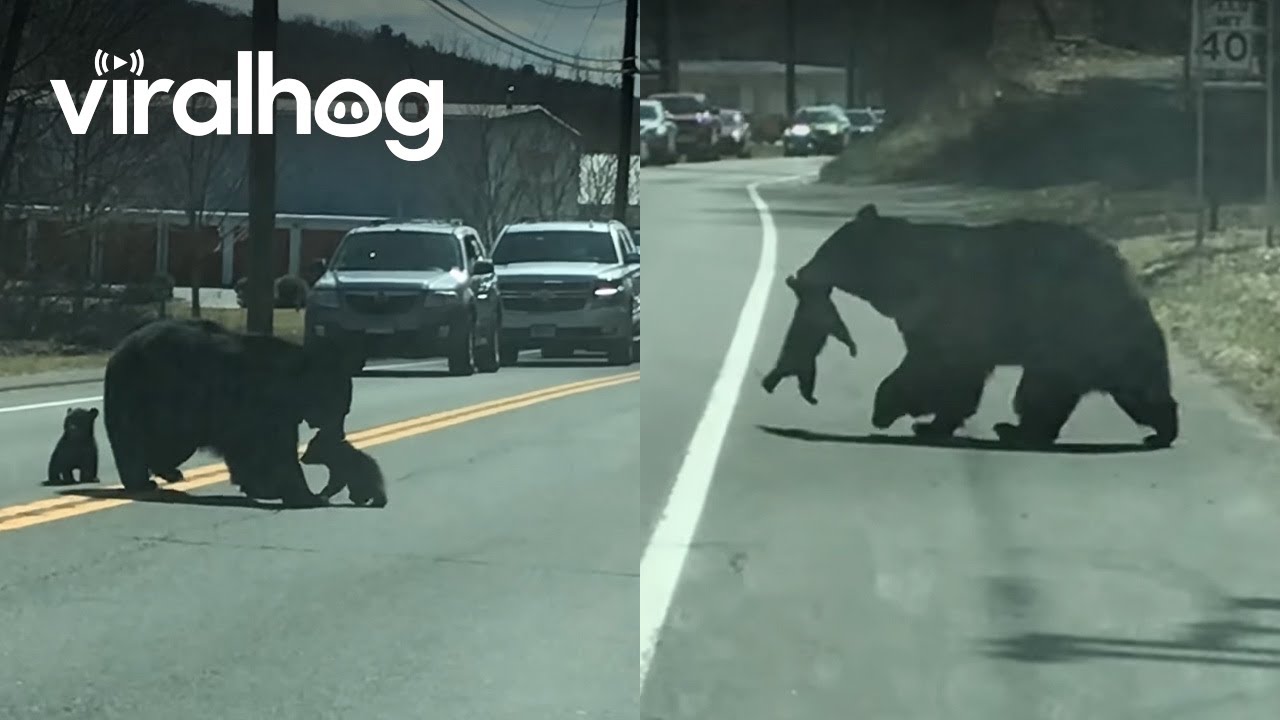
An American black bear walks the asphalt of a two-lane road in Winsted, Connecticut, a cub hanging from her jaws. She has four of them, and getting all four to the far side at the same time is the entire problem.
The filmer's first thought was that one cub had been struck by a car. Coming back fifteen minutes later, she found the mother still at work, trying to bring the whole litter across the street together. Traffic sits stopped in both directions.
The method is plain. The mother lifts a cub in her mouth and carries it, legs dangling, toward the white edge line. A second cub sits on the pavement behind her, waiting. One keeps trotting at her heels as she goes back and forth, and another climbs a roadside pole. Black bears are excellent climbers, and this one is starting early.
Four is a big family. Black bear litters run from one to five cubs, usually two or three. Cubs are born mainly in January and February, commonly while the mother hibernates, and they nurse in the den all winter. They weigh about five pounds by the time they leave the den in late March or April. This crossing happened on March 27, with the trees on the bank still bare.
Adult black bears are normally solitary. A mother with cubs is one of the exceptions, and the cubs stay with her about 18 months, or until she is ready to mate again. Every crossing like this one is part of a long stretch of keeping a young family in one piece.
People are the bigger danger. Cubs may be killed by large predators such as wolves and mountain lions, but of the black bears that are killed, young and adult, most are killed by humans. Here the drivers simply wait, and the filmer, a mother of four herself, says she can relate.