My Crittercam
My Crittercam › Coyote

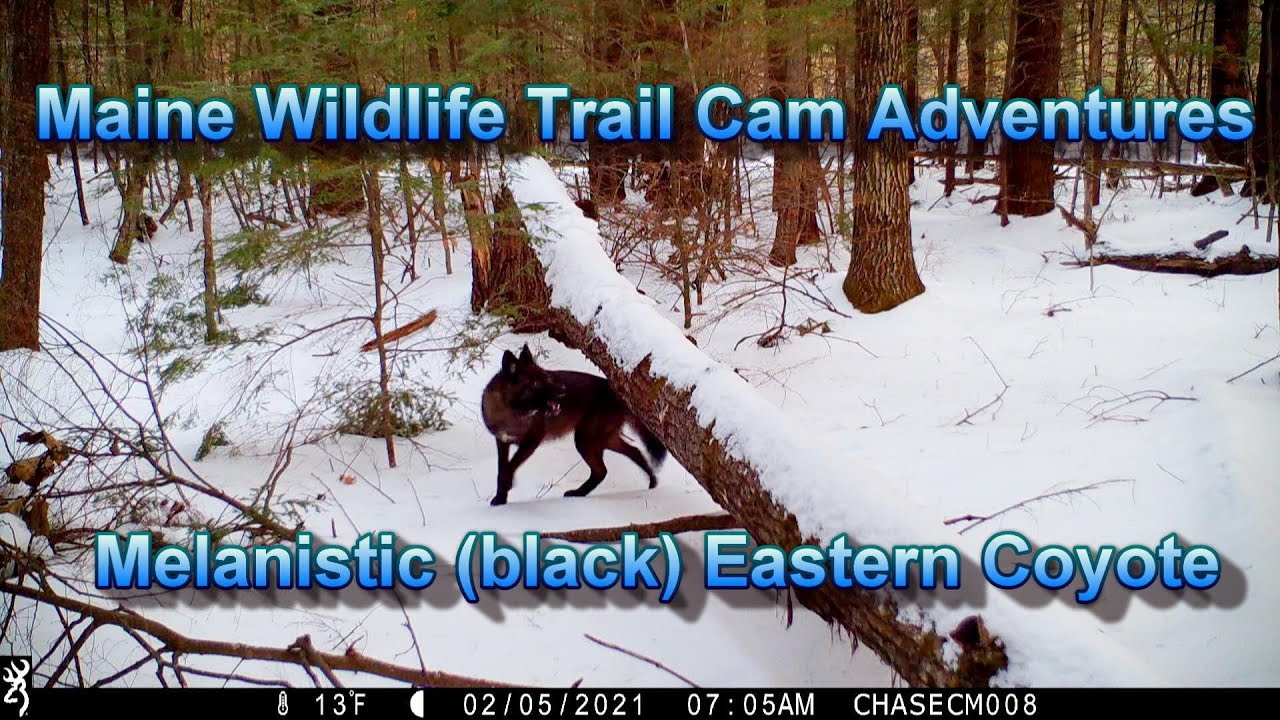
Black eastern coyote by a snowy log in Maine

A black coyote walks across snow beside a snow-covered fallen log in a forest, with cut-off blue title text above and below her and a 13°F temperature and date stamp along the bottom.

Footage: Maine Woodsbooger · 3:36 · uploaded February 14, 2021
Written by My Crittercam · published November 6, 2026

The Story

A black canid walks the edge of a snow-loaded blowdown in the Maine woods, and for a beat it reads as a wolf. It is an eastern coyote, a melanistic one, caught on two of the filmer's trail cameras.

Snow covers the forest floor, and the light is low enough for dawn or dusk. She moves at a walk past the fallen log, her coat black against the white. The filmer reads her as a young female and calls a black coyote super rare in Maine.

The filmer has a theory about this log. After a bobcat came through, a skunk-based scent lure went onto it and onto another knob nearby, and the filmer thinks that smell is what drew her in. Three cameras cover this area and two have caught her, one of them at a porcupine den site. Not a bad return on a log that smells of skunk.

Black is not on the usual coyote palette. The coat varies from blonde or reddish blonde to dark tan washed with black, with legs, ears and cheeks usually reddish. Strip that color away and a big canid crossing snow is easy to misread.

Size and shape settle it. A coyote is about one-third the size of a gray wolf, with a slighter build, large pointed ears and a pointed snout. Eastern coyotes are larger, at 35 to 45 pounds and 4 to 5 feet from nose to tail. Her age is harder to pin from a frame: eastern coyote pups in New York are fully grown at nine months.

Winter is no off-season for her kind. Coyotes molt once a year, from May into July. Mating runs January to March, and eastern coyotes, which howl all year, are highly vocal again. They are more active after sunset and at night but may be seen moving about during the day, and this camera caught her in dawn-or-dusk light.
Field Guide

A melanistic eastern coyote, judged a young female by the filmer, walks past a skunk-scented fallen log in the snowy Maine woods. Full field guide for the Coyote

Common nameCoyote
Scientific nameCanis latrans
FamilyCanidae (Dogs, wolves, foxes and jackals)
SizeLength 75 to 100 cm; 16-20 inches high at the shoulder (Yellowstone); eastern coyote 4 to 5 feet nose to tailAnimal Diversity Web, University of Michigan · National Park Service · New York State Department of Environmental Conservation
Weight7 to 21 kg; 25-35 pounds in Yellowstone; eastern coyote 35 to 45 poundsAnimal Diversity Web, University of Michigan · National Park Service · New York State Department of Environmental Conservation
Active whenEssentially nocturnal; more active after sunset and at night, but may be seen moving about during the dayAnimal Diversity Web, University of Michigan · New York State Department of Environmental Conservation
DietAbout 90% mammals: voles, mice, rabbits, squirrels, plus deer, carrion, birds, insects and fruitAnimal Diversity Web, University of Michigan · National Park Service · New York State Department of Environmental Conservation
RangeAlaska and Canada south through the US and Mexico to Central America; expanded into the eastern USAnimal Diversity Web, University of Michigan · NatureServe Explorer
LifespanIn Yellowstone: average life span 6 years, up to 13 yearsNational Park Service
Conservation statusIUCN Red List: Least Concern; NatureServe: G5NatureServe Explorer
Cam notes · Cameratrail camera, two of the filmer's cameras caught her
Cam notes · Time of daydawn or dusk
Cam notes · Seasonwinter, snow
Cam notes · PlaceMaine

Habitat

Behavior

Questions

Is it a coyote or a wolf?

A coyote is about one-third a wolf's size, with large pointed ears and a pointed snout. Coyotes run with the tail down; wolves hold it straight out.National Park Service · New York State Department of Environmental Conservation · National Park Service

How big is an eastern coyote?

Eastern coyotes weigh 35 to 45 pounds and measure 4 to 5 feet from nose to tail. Coyotes elsewhere are smaller; in Washington, adults weigh 20 to 35 pounds.New York State Department of Environmental Conservation · Washington Department of Fish and Wildlife

Are coyotes only out at night?

Coyotes are not strictly nocturnal. They are more active after sunset and at night, but may be seen moving about during the day.New York State Department of Environmental Conservation · National Park Service

Latest clips