The Story
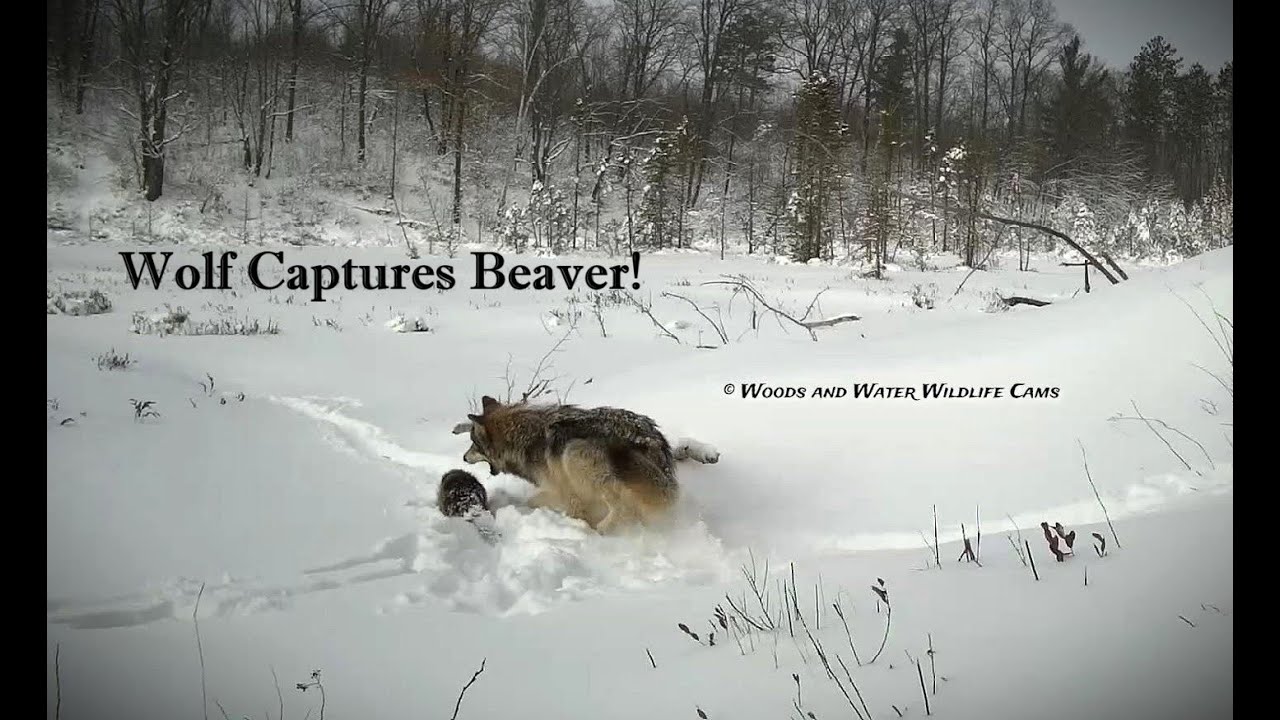
A gray wolf hits the snow head-first, mouth open, legs buried in powder, and a small dark beaver sits hunched at the end of its lunge. A trail camera records it in daylight on an open, snowbound flat below the woods.
On a camera check, the filmer points out how little trail camera footage exists of wolves catching beaver, and how much less of it in snow. This catch plays out in the open. A churned trench marks the wolf's line through the drift, and the beaver looks small against the bulk bearing down on it.
The hunter is plainly a wolf. Its coat is buff-tan grizzled with gray and black, and its tail, caked with snow, sticks straight out behind rather than curling. Wolves carry a large, blocky muzzle where a coyote's is pointed and petite. A wolf is roughly twice a coyote's size, and males weigh 70 to 115 pounds.
Beaver is on the gray wolf's menu. Wolves live mainly on medium and large hoofed mammals: in the Midwest mainly white-tailed deer, also moose, beaver and snowshoe hare; in the Rockies elk, deer, moose, bison and beaver. Researchers in northern Minnesota found that in summer, wolves there mostly hunt small prey such as beavers and deer fawns. A winter catch, on film, is the harder thing to come by.
The light adds to the luck. Gray wolves are mainly nocturnal, and their movements are usually at night. In Minnesota they spend most of their time sleeping, resting or on the move, with little time spent feeding. A daytime grab in front of a fixed lens is a narrow window, and this camera happened to be facing it.
Snow is home ground for the wolf. Its big feet work like snowshoes, and hair between the toes keeps snow from freezing there. In northern Minnesota's Voyageurs area, frozen shorelines become wolf pathways, and wind-swept frozen beaver ponds often carry less snow than the forest, making easy travel. For the beaver, the snowshoe advantage runs only one way.