My Crittercam
My Crittercam › Mule deer

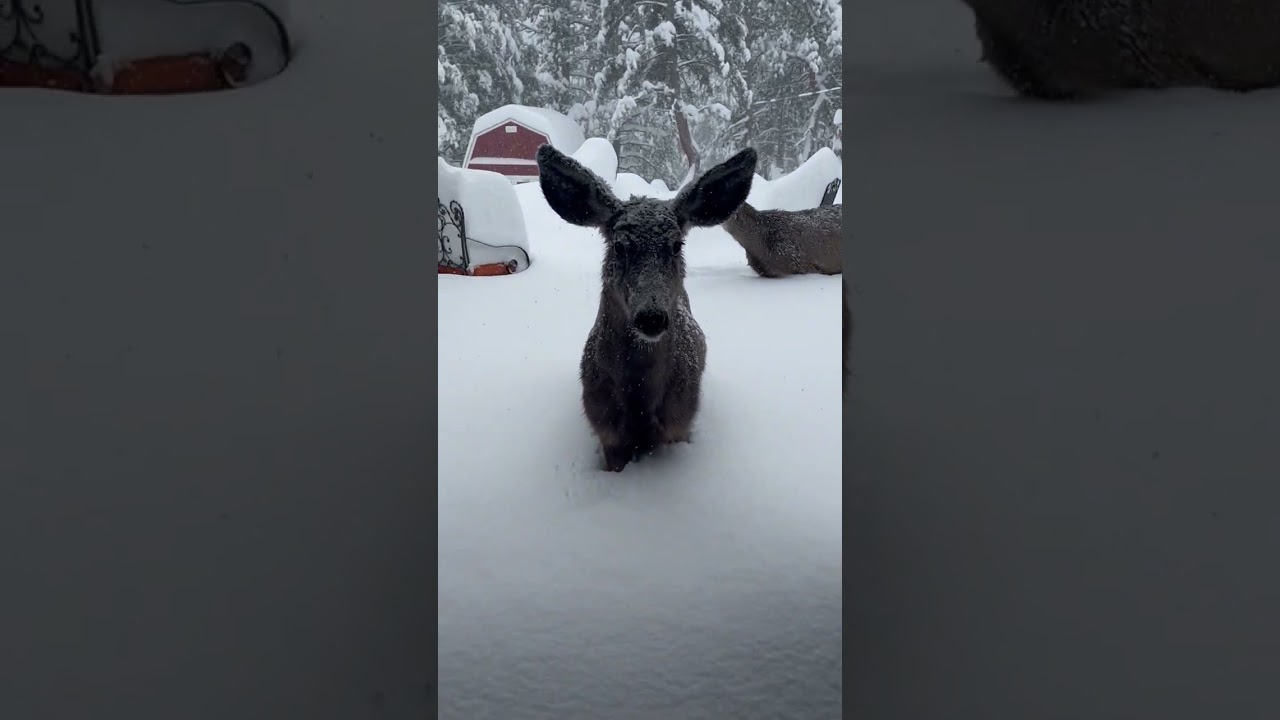
Mule deer chest-deep in four feet of new snow

A mule deer with large dark ears and snow on its head stands chest-deep in fresh snow facing the camera, a second deer half buried behind it to the right, a snow-buried iron bench at left, a snow-capped red shed and snow-laden conifers beyond, gray strips at both edges.

Footage: Backyard Visitors · 0:27 · uploaded March 18, 2024
Written by My Crittercam · published November 6, 2026

The Story

A mule deer stands sunk to the chest in a Colorado backyard, ears flared wide, snow collecting on its crown. Four feet fell overnight in the March 2024 storm, and the yard behind it is all white mounds and a snow-capped red shed.

Those ears settle the identification. On a mule deer they run about three-fourths the length of the head, and the species takes its name from them. Here they stand out dark against falling snow, turned square at the lens. A second deer is half swallowed by the drift behind it.

Snow this deep changes the arithmetic of winter. Mule deer lean heavily on browse from shrubs and twigs in the cold months, and in this yard everything low is buried. Long, snowy winters drain the fat an adult carries, and slogging through belly-deep snowpack month after month can starve fawns that lack those reserves. In harsh winters deer fall back on nipping lichen from rock faces or chewing bark off trees.

There is a human line in that budget too. Human disturbance can stress a deer into spending energy it does not need to, which may raise winter mortality. The front deer stands a few strides from the lens.

The front deer shows no antlers, which says little this late in the year, since bucks drop theirs late each winter and start growing new ones in spring. One of the deer may be a young one. If so, it was likely born last summer, when births peak from mid-June to early July, and fawns usually stay with the doe for their first full year.

Colorado sits in the Rocky Mountain region, where mule deer are especially at home. Many herds move from high summer ranges down to lower winter ranges, and in Oregon they often travel far to escape or limit snow cover. In March 2024 it came to this yard anyway.
Field Guide

A Colorado mule deer stands chest-deep in a backyard, ears wide, after four feet of snow fell overnight in the March 2024 storm. Full field guide for the Mule deer

Common nameMule deer
Scientific nameOdocoileus hemionus
FamilyCervidae (Deer family)
SizeMales: body length 126 to 168 cm, shoulder height 84 to 106 cm. Females: body length 125 to 156 cm, shoulder height 80 to 100 cm.Animal Diversity Web, University of Michigan
WeightBucks may weigh up to 350 lbs.; does rarely surpass 150 lbs.National Park Service
DietIntermediate feeder: woody and herbaceous forage in approximate equal proportions, plus acorns, legume seeds and fleshy fruits.Animal Diversity Web, University of Michigan
Active whenCrepuscular; most often seen in the early morning and late evening.National Park Service
RangeMost of North America west of the 100th meridian, from 23 degrees to 60 degrees N; in the West from Canada to Mexico.Animal Diversity Web, University of Michigan · National Park Service
LifespanUsually 9 to 11 years in the wild; average lifespan in captivity 22 years.National Wildlife Federation · Animal Diversity Web, University of Michigan
Conservation statusIUCN Red List: Least Concern. NatureServe: G5.Animal Diversity Web, University of Michigan · NatureServe
Cam notes · Time of dayday
Cam notes · Seasonlate winter, the March 2024 snowstorm
Cam notes · Placea backyard in Colorado

Habitat

Behavior

Questions

What do mule deer eat when snow covers everything?

In winter they depend heavily on browse from shrubs and twigs. In harsh winters they resort to nipping lichen from rock faces or chewing bark off trees.National Park Service · NASA Earthdata

How do mule deer get through snow this deep?

Many move from higher summer ranges to lower winter ranges and live off their fat reserves. Long, snowy winters drain those reserves, and belly-deep snowpack month after month can starve fawns that lack them.Animal Diversity Web, University of Michigan · NASA Earthdata

How can you tell these are mule deer and not another deer?

Mule deer have large ears, about three-fourths the length of the head, and a thin, black-tipped tail. Bucks carry antlers that fork into a 'Y'.National Wildlife Federation · National Park Service · National Park Service

Latest clips