The Story
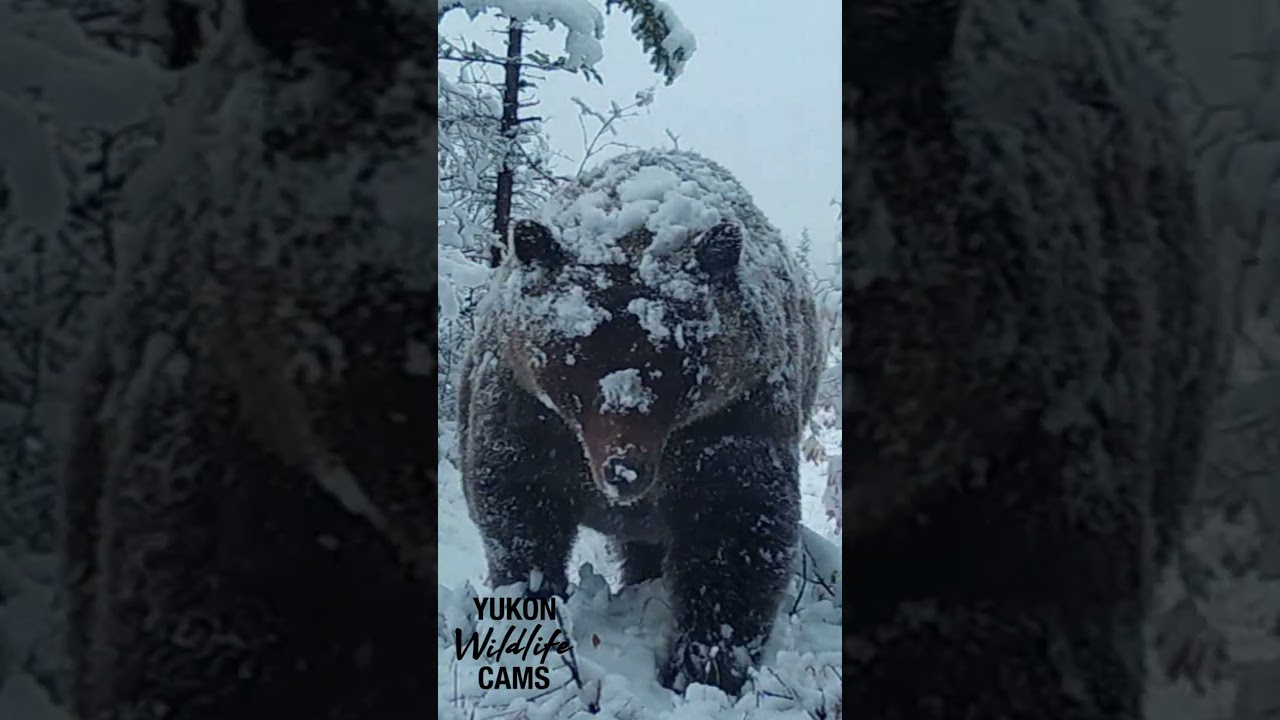
Snow sits on the bridge of the muzzle in a neat white cap, and the animal wearing it is a grizzly bear, walking straight at the lens. More lies heaped across its brow and along its back, fresh from an early-season snowfall in the Yukon.
It pushes out of snow-bowed brush at the right of the frame, a thin conifer behind it against a flat gray sky. The bear keeps coming, head low, legs sunk in the white, until its fur fills the lens.
Under all that snow, the head and feet give it away. The ears are small and rounded, set wide on a broad head, and a grizzly's ears are less prominent than a black bear's. Halfway through, a forepaw lifts and the front claws show long and pale. Grizzly front claws are longer and less curved than a black bear's, suited to digging rather than climbing. The shoulder hump, a large muscle mass above the shoulders, cannot be read head-on under this much snow. Nor can color: grizzlies run from blond to black, often with pale-tipped guard hairs.
Snow has come, and this bear is still on its feet. Far to the south, lower-48 grizzlies typically enter dens between October and December, males later than females. In northern Alaska bears may spend up to 8 months in dens, while on Kodiak some males stay active all winter. None of these is a Yukon figure.
Before any den comes food. In autumn hyperphagia a grizzly may gain more than three pounds a day; this one is broad and heavy, though how much of that is autumn fat the footage cannot say. In the den they do not eat, drink, urinate or defecate, breathing slows to one breath every 45 seconds, and bears may lose 15-30% of body weight. For now, the only weight this bear has not eaten is the snow on its muzzle.