The Story
A patrol plane crosses the far northwest corner of Wood Buffalo National Park in 1957, and along the Nyarling River below stand about two hundred bison. Scientists had already written off the wood bison, the bigger bison of the northern forest, as gone in its pure form.
The park, straddling Alberta and the Northwest Territories, was created in 1922 to save them. Three years later Ottawa began shipping 6,673 plains bison north from Wainwright, over biologists' protests. The two kinds bred, and cattle diseases spread.
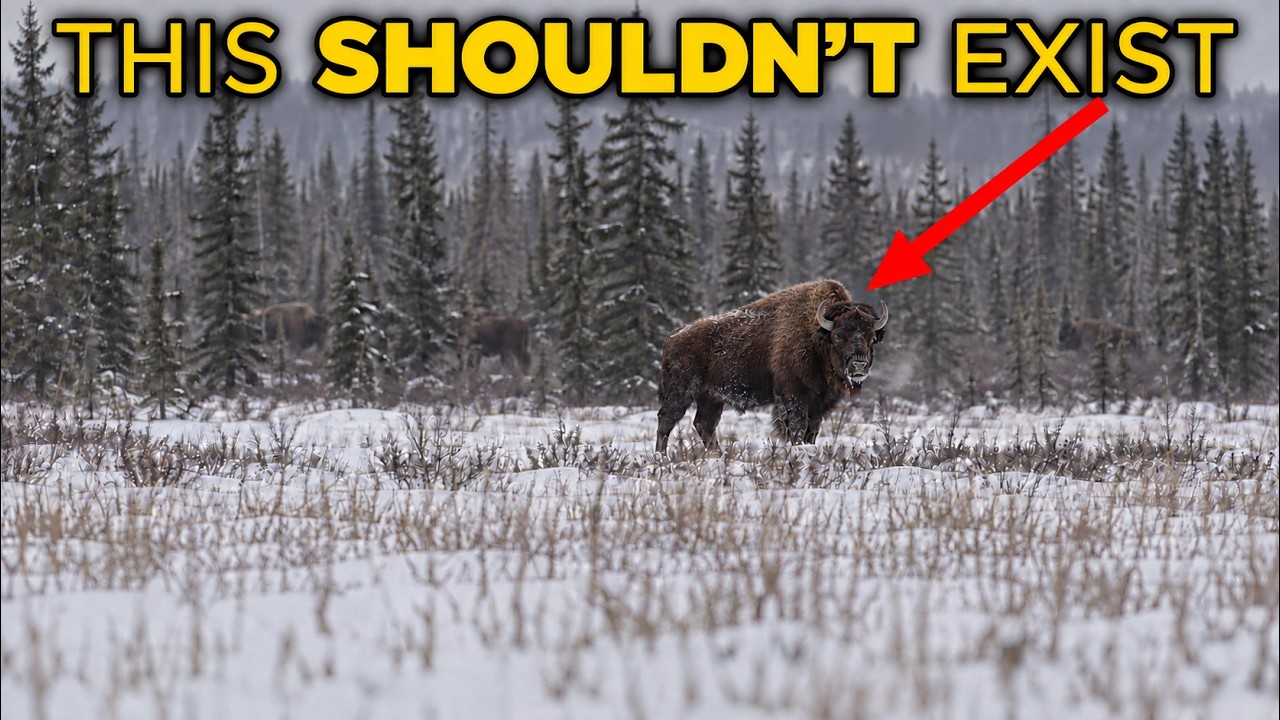
They are two subspecies of one species. Wood bison average about 15 percent heavier, with a taller hump peaking forward of the front legs and woolly hair along the ribs. With no test that could read ancestry, biologists Nicolas Novakowski and A. W. F. Banfield measured Nyarling bison against museum specimens from before 1925.
The measurements overlapped. The herd was declared pure, guarded by country nothing else could cross, and the rescue began. In 1963 eighteen tested animals were trucked north across the Mackenzie River; in 1965 about two dozen more went to Elk Island National Park. Nearly every herd that brought the wood bison back, as far as Alaska and Russia, descends from those few dozen.
Then the two words holding it up, pure and isolated, began to slip. A 1986 skull study suggested about five percent of the herd's genes came from Wainwright. In 1989 Jack Van Camp argued nothing showed the herd had ever been cut off. In August 2026 a study in Science read 160 bison genomes and settled half the quarrel: wood and plains bison are genetically distinct, yet every living wood bison herd carries seven to sixty-four percent plains ancestry from the 1920s shipments.
The animals kept going regardless. In 2015, 130 wood bison were released along the Innoko River in Southwest Alaska, and Canada's wildlife assessment committee, COSEWIC, rates them Special Concern. What nearly pure is worth is still debated, a question the bison have never once raised.