Great Horned Owl field guide
Field Guide
| Common name | Great Horned Owl |
|---|---|
| Scientific name | Bubo virginianus |
| Family | Strigidae |
| Size | Length: 18-24 in (46-63 cm); female largerNational Audubon Society |
| Weight | 32-88 oz (910 g-2.5 kg); females average about 1.7 kg, males 1.3 kgNational Audubon Society · Animal Diversity Web, University of Michigan Museum of Zoology |
| Wingspan | 3 ft 4 in-4 ft 9 in (1.02-1.45 m)National Audubon Society |
| Lifespan | Average 13 years in the wild; wild record 28 years; captive record 35 yearsAnimal Diversity Web, University of Michigan Museum of Zoology |
| Diet | Varied, mostly mammals and birds: rats, mice, rabbits, skunks, some birds up to the size of geeseNational Audubon Society |
| Active when | Hunts mostly at night, sometimes at duskNational Audubon Society |
| Range | Found almost throughout North America and much of South America; no regular migrationNational Audubon Society |
| Conservation status | IUCN Red List: Least Concern; population 5,700,000 (Audubon)National Audubon Society · Animal Diversity Web, University of Michigan Museum of Zoology |
Field Marks
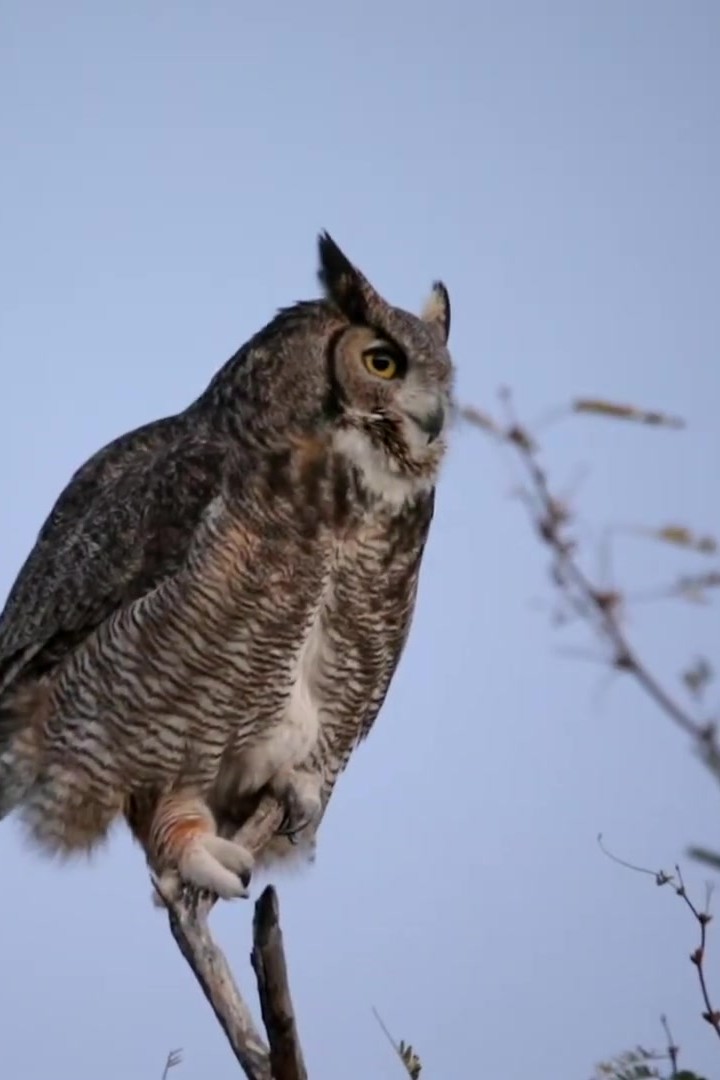
- Large size, conspicuous "ear" tufts, a white throat, and horizontal bars on the belly.National Audubon Society
- The horn-like tufts are feathers, usually darker than the rest of the head; they are not real horns.Animal Diversity Web, University of Michigan Museum of Zoology · BirdNote
- Eyes are different shades of yellow; white or tan coloring around a black bill.Animal Diversity Web, University of Michigan Museum of Zoology
- Back is darker, mottled with blacks and browns; underbelly white with brown and black bars.Animal Diversity Web, University of Michigan Museum of Zoology
- Compare to the smaller Long-eared Owl.National Audubon Society
Habitat
- Found in practically all habitats in North America, from swamps to deserts to northern coniferous forests near treeline.National Audubon Society
- Most commonly found in interspersed areas of woodland and open fields.Animal Diversity Web, University of Michigan Museum of Zoology
- Habitats include grasslands, deserts, swamps, marshes, mangroves, and both rural and urban human settlements.Animal Diversity Web, University of Michigan Museum of Zoology
- In breeding season it avoids tundra and unbroken grassland, since it requires some trees or heavy brush for cover.National Audubon Society
- Lives at elevations from sea level up to 3352.8 meters (11,000 ft).Animal Diversity Web, University of Michigan Museum of Zoology
Behavior
- Watches from a high perch, then swoops down to capture prey in its talons.National Audubon Society
- Has extremely good hearing and good vision in low light conditions.National Audubon Society
- Takes prey as varied as rabbits, hawks, snakes, and even skunks, and will attack porcupines, often with fatal results for both.National Audubon Society
- Eats some birds (especially in the north) up to the size of geese, ducks, hawks, and smaller owls; also snakes, lizards, frogs, insects, scorpions, rarely fish.National Audubon Society
- Song is a series of low, far-carrying hoots, hoo, hoo-hoo, hoo, hoo, with second and third notes shorter.National Audubon Society
- When a pair calls in a duet, the female usually hoots first, and the male replies at a lower pitch.BirdNote
- A pair may call back and forth or overlap their hoots; often heard during dark winter evenings and pre-dawn mornings.BirdNote
- Males hoot throughout the year, but females only hoot during mating season.Animal Diversity Web, University of Michigan Museum of Zoology
- Great Horned Owls also shriek (an owlet begging or a female defending its nest), adults bark at threats, and they hiss, pop, meow, coo, and snap their bills.BirdNote
- Breeding pairs are territorial; hooting mainly sets territory limits, and territory disputes can be fatal. Territories are generally 5.26 to 5.56 sq km.Animal Diversity Web, University of Michigan Museum of Zoology
- May begin nesting very early in the north (late winter); in courtship the male performs a display flight and feeds the female.National Audubon Society
- Breeding occurs between the months of November and April; owls nest later at higher latitudes.Animal Diversity Web, University of Michigan Museum of Zoology
- Typically uses an old nest of a hawk, eagle, crow, or heron, usually 20-60' above ground; also cliff ledges, caves, stumps, sometimes the ground.National Audubon Society
- Lays 2-3, sometimes 1-5, rarely 6 eggs; incubation mostly by female, 28-35 days. Young can fly at about 9-10 weeks.National Audubon Society
- Crows (Corvus brachyrhynchos) or raccoons sometimes eat their eggs.Animal Diversity Web, University of Michigan Museum of Zoology
Winter
- Deep hoots may be heard rolling across the forest on mid-winter nights.National Audubon Society
- In the north in winter, may store uneaten prey and later thaw the frozen carcass by "incubating" it.National Audubon Society
- No regular migration, but individuals may wander long distances in fall and winter, some moving southward.National Audubon Society
- In northern latitudes they tend to have larger core bodies and a longer wingspan.Animal Diversity Web, University of Michigan Museum of Zoology
- Nesting in late winter in the north may give young time to learn hunting skills before next winter.National Audubon Society
Questions
How big is a Great Horned Owl?
It is 18-24 in (46-63 cm) long with a wingspan of 3 ft 4 in-4 ft 9 in. Females are larger.National Audubon Society
Are those real horns?
No. They are two tufts of feathers that stick up from the top of the head.BirdNote
What does it eat?
Mostly mammals and birds, such as rats, mice, rabbits, and skunks. It also eats snakes, lizards, frogs, insects, and scorpions.National Audubon Society
Why do two owls hoot back and forth?
A pair duets: the female usually hoots first and the male replies at a lower pitch. Hooting is used to set territory and find mates.BirdNote · Animal Diversity Web, University of Michigan Museum of Zoology
When do they nest?
Breeding occurs between November and April. In the north they may begin nesting very early, in late winter.Animal Diversity Web, University of Michigan Museum of Zoology · National Audubon Society
Where does it nest?
Usually in an old nest of another large bird such as a hawk, eagle, crow, or heron, 20-60' above ground. It adds little or no nest material.National Audubon Society
How long do they live?
The average life expectancy is 13 years. The wild record is 28 years.Animal Diversity Web, University of Michigan Museum of Zoology
Do they eat chickens?
Great horned owls may prey upon poultry raised as livestock. They also eat many rodents considered pests.Animal Diversity Web, University of Michigan Museum of Zoology
Do they migrate?
There is no regular migration. Some individuals wander long distances in fall and winter.National Audubon Society
Clips
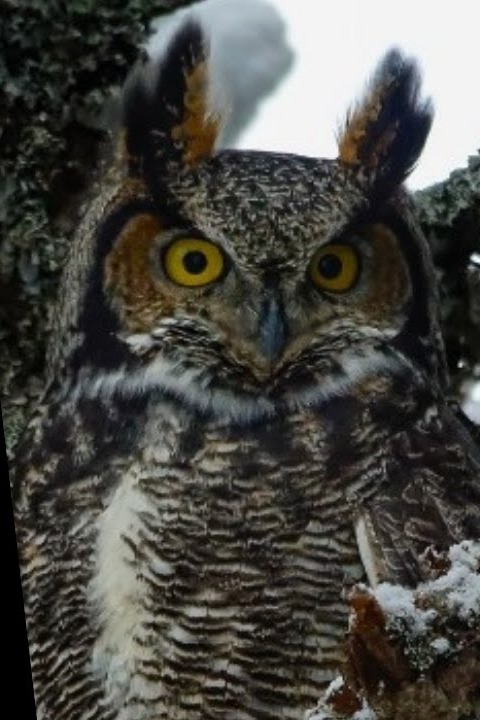
Following a morning of crow alarm calls, a birder finds her first great horned owl perched in a lichen-covered tree, and a nesting blue jay later dives at it.
A great horned owl hoots from a bare branch in desert daylight until a second owl flies in and the pair mate.
Sources
- Great Horned Owl - Guide to North American Birds, National Audubon Society
- Bubo virginianus (great horned owl), Animal Diversity Web, University of Michigan Museum of Zoology
- Great Horned Owl Duet, BirdNote
- Voices and Vocabularies - Great Horned Owls, BirdNote