Red fox field guide
Field Guide
| Common name | Red fox |
|---|---|
| Scientific name | Vulpes vulpes |
| Family | Canidae (dog family (canids)) |
| Size | Head and body 455-900 mm, tail 300-555 mm; adults 14-20 in tall (Isle Royale); 39-43 in long including tail (Connecticut)Animal Diversity Web, University of Michigan · National Park Service · Connecticut Department of Energy & Environmental Protection |
| Weight | 3 to 14 kg range-wide; 7 to 15 lb in Connecticut, averaging 10 to 11 lb; males slightly heavierAnimal Diversity Web, University of Michigan · Connecticut Department of Energy & Environmental Protection |
| Lifespan | Average 3 years in the wild; 10 to 12 years known in captivityAnimal Diversity Web, University of Michigan |
| Diet | Omnivore: mostly rodents, rabbits, insects and fruit, plus birds, eggs, carrion and garbage; eats 0.5 to 1 kg a dayAnimal Diversity Web, University of Michigan · Connecticut Department of Energy & Environmental Protection |
| Active when | Year-round, no hibernation; mainly dawn, dusk and night, but daytime sightings are not unusualConnecticut Department of Energy & Environmental Protection · Animal Diversity Web, University of Michigan |
| Range | Most of North America from Baffin Island and Alaska to the southern US, except coastal western Canada, Oregon, California, the Great Plains, the southwestern desert and the extreme SoutheastConnecticut Department of Energy & Environmental Protection |
| Conservation status | IUCN Red List: Least Concern (as listed on NatureServe Explorer); NatureServe: G5 (Secure), N5 in the United States and CanadaNatureServe Explorer |
Field Marks
- Reddish coat, black legs and ears, white underside, and a long, bushy, white-tipped tail.Connecticut Department of Energy & Environmental Protection
- Gray fox is often confused with it, but has a gray coat, shorter muzzle and ears, and lacks the white tail tip.Connecticut Department of Energy & Environmental Protection
- Black 'booties' on all four legs and the white tail tip separate it from the gray fox, even in grayish individuals.Vermont Fish & Wildlife Department
- Tail is proportionally longer than a coyote's and is held horizontally behind the fox when it runs.Connecticut Department of Energy & Environmental Protection
- Cross foxes are reddish brown with a black stripe down the back and another across the shoulders; about 25% of red foxes.Animal Diversity Web, University of Michigan
- Silver foxes range from strong silver to nearly black, about 10% of red foxes; the silver phase is black fur with silver-tipped guard hairs.Animal Diversity Web, University of Michigan · National Park Service
Habitat
- Uses forest, tundra, prairie, desert, mountains, farmland and urban areas, from sea level to 4500 m.Animal Diversity Web, University of Michigan
- Prefers a mix of forest and open fields and hunts along the 'edge' between them.Connecticut Department of Energy & Environmental Protection
- Commonly inhabits suburbs and cities, especially yards, parks and golf courses next to undeveloped habitat.Connecticut Department of Energy & Environmental Protection
- Researchers have found significant red fox populations in more than 100 major cities worldwide.National Wildlife Federation
- Often rests or sleeps in thick cover on a wooded ridge or hilltop, using dens in wet weather and for raising young.SUNY College of Environmental Science and Forestry
- Dens are often remodeled woodchuck or badger burrows; foxes also den in crawl spaces under decks and sheds.USDA Forest Service · Connecticut Department of Energy & Environmental Protection
Behavior
- Mousing: the fox stands motionless listening, then leaps high and drives its forelimbs straight down to pin the mouse.Animal Diversity Web, University of Michigan
- In deep snow it lands head first, up to 16 ft from its launch point, steering with its tail on the way down.National Park Service
- It can hear a mouse or vole chewing or squeaking as far as 100 feet away and under as much as 3 feet of snow.National Park Service
- In a Czech study, mousing jumps in high cover or snow succeeded 72.5% of the time when aimed near magnetic north and 60% due south, under 18% otherwise; researchers suggest magnetic alignment.Royal Society / Europe PMC (PMC3097881) · National Park Service
- May cache surplus food, covering it with soil, grass, leaves or snow and marking it with urine; it is very good at relocating caches.Connecticut Department of Energy & Environmental Protection · Animal Diversity Web, University of Michigan
- Mostly solitary hunters; foxes do not form packs. A range holds one adult male and one or two females with young.Connecticut Department of Energy & Environmental Protection · Animal Diversity Web, University of Michigan
- Breeding runs January through March in Connecticut; gestation is 51 to 53 days, with litters averaging 4 or 5 pups (kits).Connecticut Department of Energy & Environmental Protection
- Kits are born blind; eyes open at 9 to 14 days; they leave the den at 4 to 5 weeks and are weaned by 8 to 10 weeks.Animal Diversity Web, University of Michigan
- Both parents bring food and guard the den; the male feeds the vixen but does not enter the maternity den.Connecticut Department of Energy & Environmental Protection · Animal Diversity Web, University of Michigan
- Parents may move pups between dens as many as three times before they are 6 weeks old.USDA Forest Service
- Young disperse in fall; males usually leave before females and move farther. Dispersal ranges from about 10 km to almost 400 km.USDA Forest Service · Animal Diversity Web, University of Michigan
- Common call: a raspy, single-syllable scream or bark repeated every 3-10 seconds, a frequent source of reports to Connecticut wildlife staff.Connecticut Department of Energy & Environmental Protection
- Calls range from soft huffs and whines to loud coughing 'gekkering', barks and screams; males may fight over mates through gekkering and posturing.Wildwood Park & Zoo, City of Marshfield, Wisconsin
- 28 kinds of vocalizations have been described, and individual voices can be told apart; scent marks use urine, feces and several glands.Animal Diversity Web, University of Michigan
Winter
- Uses its long tail in cold wind to cover the bare skin of its nose and foot pads.National Park Service
- Coats are often darker at higher latitudes, and winter coats are both darker and thicker.National Park Service
- Prefers to sleep in the open, even in winter; the den is mainly a nursery.Minnesota Department of Natural Resources
- Voles and mice are more active by day under deep snow in winter, so red foxes are more day-active then too.National Park Service
- Mountain (Sierra Nevada) red foxes have a dense winter coat, and fur over the toe pads works like a snowshoe.National Park Service (Yosemite National Park)
Questions
How big is a red fox?
Northeastern red foxes average about 11 lb for males and 9 lb for females; large house cats can weigh more. Adults grow up to 14-20 inches tall (Isle Royale).National Park Service · National Park Service
Is a red fox dangerous to people?
Healthy foxes pose virtually no danger to humans and are seldom aggressive toward people. Fox attacks on people, including children, are rare.Connecticut Department of Energy & Environmental Protection · North Carolina Wildlife Resources Commission
If I see a fox in daylight, is it rabid?
Not necessarily; it is now common to see foxes in the daytime and in urban or suburban areas. Signs of rabies include aggression, stumbling or foaming at the mouth.North Carolina Wildlife Resources Commission
What does a red fox eat?
It is an omnivore that eats mostly rodents, rabbits, insects and fruit, plus birds, eggs, carrion and garbage. Its diet generally shifts from mostly animal matter in winter to insects and fruit in summer and fall.Animal Diversity Web, University of Michigan · Connecticut Department of Energy & Environmental Protection · USDA Forest Service
Why does a fox jump head first into snow?
It locates rodents under the snow by sound, then leaps high and pounces from above. In a Czech study, north-east-oriented jumps tended to succeed more often, which the researchers suggest is magnetic alignment.Animal Diversity Web, University of Michigan · Royal Society / Europe PMC (PMC3097881)
What is that screaming sound at night?
Red foxes give a raspy, single-syllable scream or bark repeated every 3-10 seconds. A vixen gives a loud scream when trying to attract a male.Connecticut Department of Energy & Environmental Protection · Wildwood Park & Zoo, City of Marshfield, Wisconsin
Is a black or silver fox a different species?
No; cross and silver foxes are color variants of the red fox. Cross foxes are about 25% and silver foxes about 10% of red foxes.Animal Diversity Web, University of Michigan
Where does a red fox sleep?
It prefers to sleep in the open, even in winter; the den is mainly a nursery but is also used in wet weather. It often rests in thick cover on wooded ridges or hilltops.Minnesota Department of Natural Resources · SUNY College of Environmental Science and Forestry
I found fox kits alone. Are they orphaned?
Parents are usually nearby, usually out of sight and hunting. Unless a kit appears weak, injured or alone and crying for hours, or both parents are believed dead, leave it alone.Wisconsin Department of Natural Resources
Why does the fox look patchy or bald?
Hair loss has several causes; a common one is mange, caused by a mite, and one in every 20 Indiana foxes has it. Connecticut DEEP says infected foxes usually die within 2 to 4 months.Indiana Department of Natural Resources · Connecticut Department of Energy & Environmental Protection
Clips
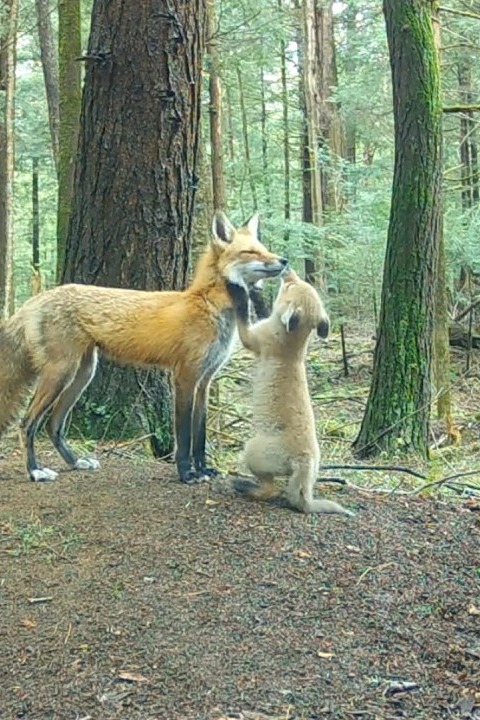 Red fox mother greets a pup between hunts
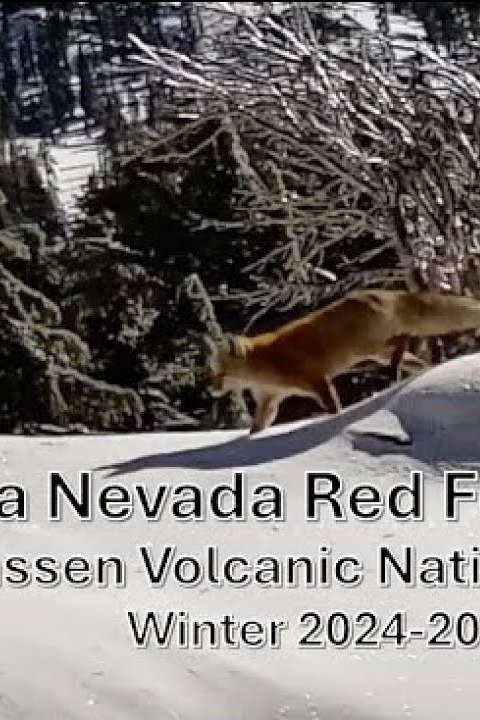 Sierra Nevada red fox walks its sunlit snow perch
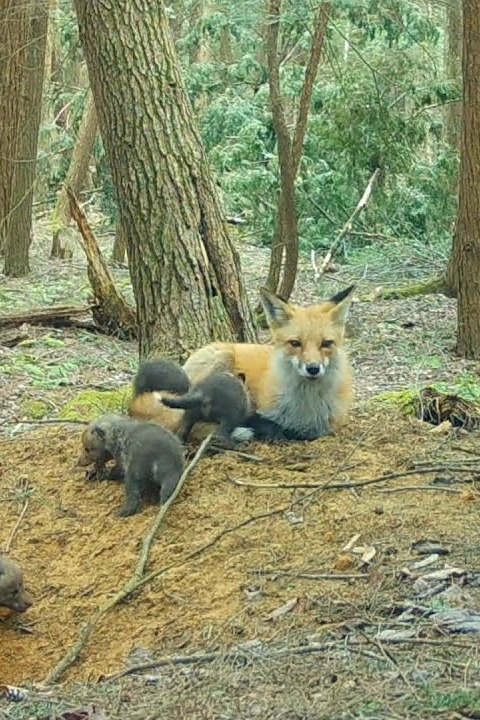 Red fox vixen calls her gray kits out of the den
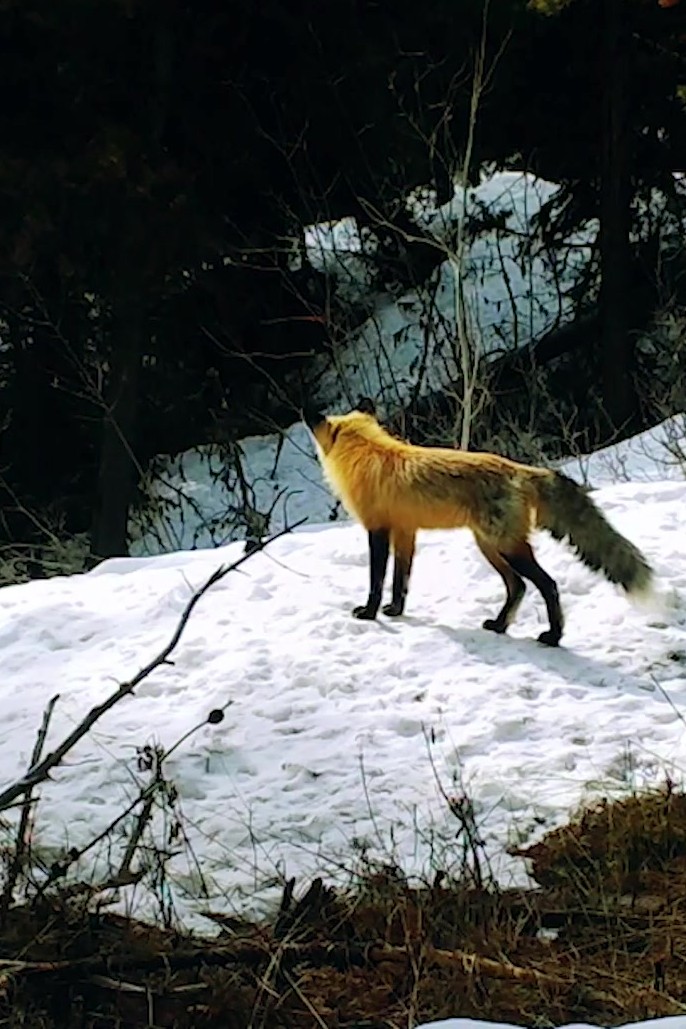 Red fox screams, then barks, on a trail camera
A red fox vixen named Sage feeds and nurses seven pups through a 24-hour run of hunting by Lake Ontario, then crows mob her as she rests at the den.
On a sunlit, snow-capped rock at about 8,500 feet in Lassen Volcanic National Park, a Sierra Nevada red fox walks the crest, then stretches and curls up in the winter sun.
On April 2, after carrying a muskrat back from the lakeshore, a red fox vixen calls her dark gray kits out of their hemlock-wood den for the first time.
A single red fox screams, then switches to a bark, in front of a trail camera in northwest Wyoming.
Sources
- Vulpes vulpes (red fox), Animal Diversity Web, University of Michigan
- Red Fox fact sheet, Connecticut Department of Energy & Environmental Protection
- Red Fox, Minnesota Department of Natural Resources
- Fish and Wildlife: Red Fox, Indiana Department of Natural Resources
- Red Fox Fact Sheet, Vermont Fish & Wildlife Department
- Vulpes vulpes, red fox (Fire Effects Information System species review, Tesky 1995), USDA Forest Service
- Vulpes vulpes (Global rank G5; IUCN Least Concern), NatureServe Explorer
- Species Spotlight - Red Fox, National Park Service
- Red Fox - Isle Royale National Park, National Park Service
- Red Fox (from Saunders 1988, Adirondack Mammals), SUNY College of Environmental Science and Forestry
- Directional preference may enhance hunting accuracy in foraging foxes (Cerveny et al. 2011, Biology Letters 7:355), Royal Society / Europe PMC (PMC3097881)
- Red Fox - Meet our Zoo Animals, Wildwood Park & Zoo, City of Marshfield, Wisconsin
- Coexist with Foxes, North Carolina Wildlife Resources Commission
- Red Fox - Keep Wildlife Wild, Wisconsin Department of Natural Resources
- Sierra Nevada Red Fox Description and Biology, National Park Service (Yosemite National Park)
- Ultimate Opportunists (National Wildlife magazine, April-May 2018), National Wildlife Federation