My Crittercam
My Crittercam › Canada lynx

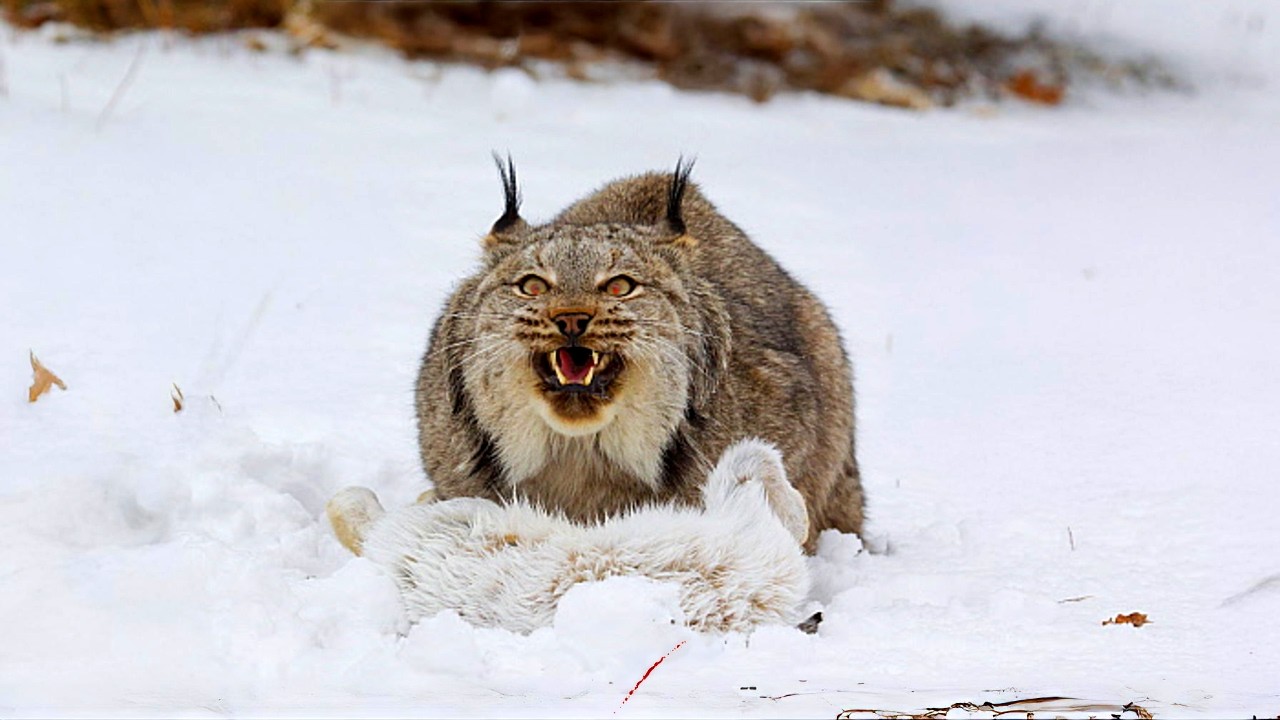
Canada lynx snarls over a hare in the snow

A Canada lynx with long black ear tufts crouches behind a white hare lying in the snow, mouth open and teeth bared toward the camera.

Footage: BEASTERS · 13:50 · uploaded January 26, 2025
Written by My Crittercam · published November 6, 2026

The Story

A Canada lynx crouches over a white hare in the snow, black ear tufts straight up, lips drawn back from long canines, and snarls down the lens.

That frame fronts a longer film about this northern cat, and the sound in its title is the real draw. A pair of lynx look as if they are minding their own business. Then the noise starts, and it only gets worse the longer it runs.

Lynx share much of the house cat's vocabulary: mews, yowls, spits and hisses. The yowling and growling peak in the breeding season, the one stretch of winter when these solitary adults typically stop avoiding each other. A big-cat scientist read two lynx caterwauling face to face on an Ontario road as a mating-season standoff, a ritual shouting match that lets both cats skip the real fight.

The hunting sequence is quieter and faster. Snowshoe hares feed through a heavy storm. A lynx moves forward through the snow, and just before it springs, the hares sense it and panic. The chase runs through deep snow, the hare dodging, leaping, even ducking under the surface, until the lynx takes it by the head while the rest of the group bolts.

The opening of that hunt is the textbook lynx method: stalk to within a few short bounds, then pounce. The feet do the heavy lifting. They are huge and furry, the toes spreading wide in soft snow, and they work like snowshoes, which likely gives the lynx a seasonal edge over other terrestrial hare predators.

It needs every edge it can get. Snowshoe hares make up 35 to 99 percent of a lynx's prey by biomass, and the two populations rise and fall together on a cycle of about 9.6 years, the cats lagging just behind. When hares crash, kitten deaths climb and fewer females get pregnant.

Up close, with that winter neck ruff fluffed out, the cat in the frame looks well past the species' 15 to 30 pounds and entirely unwilling to share.
Field Guide

A Canada lynx snarling over a white hare in the snow fronts a film that pairs the cat's screams with a deep-snow hare chase. Full field guide for the Canada lynx

Common nameCanada lynx
Scientific nameLynx canadensis
FamilyFelidae (cats)
DietCarnivore; snowshoe hares make up 35-99% of prey biomass, plus rodents, birds, fish and carrionUSDA Forest Service · Animal Diversity Web, University of Michigan Museum of Zoology
Size30 to 35 in (75 to 90 cm) long; tail 50 to 130 mmU.S. Fish & Wildlife Service · Animal Diversity Web, University of Michigan Museum of Zoology
Weight15 to 30 pounds (6 to 14 kilograms); males slightly heavier than femalesU.S. Fish & Wildlife Service · Animal Diversity Web, University of Michigan Museum of Zoology
RangeBoreal forest across most of Canada and Alaska; in the contiguous US, resident breeding populations in northern Maine/New Hampshire, NE Minnesota, NW Montana/N Idaho, N-central Washington, western ColoradoU.S. Fish & Wildlife Service
Active whenMost active between dusk and dawn; hides during the dayUSDA Forest Service
LifespanUp to 14.5 years in the wild; 26.75 years recorded in captivityAnimal Diversity Web, University of Michigan Museum of Zoology
Conservation statusIUCN Red List: Least Concern; NatureServe: G5 (Secure); COSEWIC: Not at Risk; US Endangered Species Act: Threatened (contiguous US distinct population segment, listed 2000)Animal Diversity Web, University of Michigan Museum of Zoology · NatureServe Explorer · U.S. Fish & Wildlife Service
Cam notes · Time of dayday
Cam notes · Seasonwinter, snow on the ground

Habitat

Behavior

Questions

Why do lynx scream like that?

Lynx yowl and growl most often during the breeding season. Two lynx caterwauling face to face are likely in a mating-season standoff, a ritualized way to avoid a real fight.San Diego Zoo Wildlife Alliance · Live Science

What do lynx hunt?

Snowshoe hares make up 35-99% of a lynx's prey biomass, with rodents, birds, fish and carrion filling in. When hares are scarce, lynx lean more on grouse, ptarmigan, squirrels and microtine rodents.USDA Forest Service · Animal Diversity Web, University of Michigan Museum of Zoology · Alaska Department of Fish and Game

How is a lynx different from a bobcat?

A lynx tail tip is black all the way around, while a bobcat's is black only on top with a white underside. Lynx also have much longer ear tufts, much larger furry paws and longer hind legs.Minnesota Mammals, Natural Resources Research Institute, University of Minnesota Duluth · Alberta Institute for Wildlife Conservation · U.S. Fish & Wildlife Service

Latest clips