My Crittercam
My Crittercam › White-tailed deer

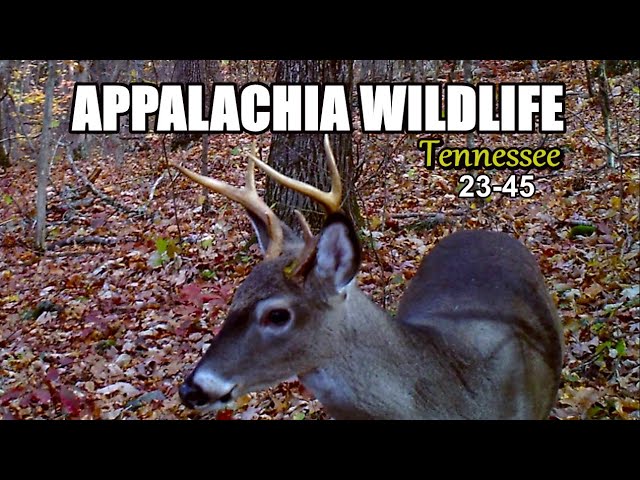
Close-up of a white-tailed buck in fall leaves

Close-up of a white-tailed buck's head and branching antlers in profile, white band behind the nose and white ring around the eye, fall leaf litter behind, burned-in title text along the top.

Footage: DONNIE LAWS Appalachia · 14:08 · uploaded November 6, 2023
Written by My Crittercam · published November 6, 2026

The Story

The first freeze has reached a wooded ridge in the East Tennessee foothills of the Smoky Mountains, and a white-tailed buck stands close enough to a hidden trail camera that his head and antlers fill the frame.

It is the week of October 30, 2023. Leaves are past peak and falling fast, the pond has dried down to little more than weeds, and the bucks are coming out of the back ridges. Some big ones are about, especially at night. The little ones act as though they are big ones.

Up close, the field marks read like a checklist. A white band runs behind the nose, a white ring circles the eye, and the inside of the ear is white. The coat has turned grayish-brown, the winter version. Deer molt into it in September: dense woolly underfur beneath long hollow guard hairs. His antlers spread and branch, as an adult male's do; a younger male may carry a single point.

Those antlers grew in velvet from spring and hardened by fall. In Connecticut the breeding season runs from late October through early January, peaking in the last two weeks of November, and Missouri's peaks in mid-November. Bucks rub trees and paw scrapes as it builds, and rivals settle access to a doe by clashing antlers rather than guarding harems. On this ridge the younger bucks are already trailing the does, and two big ones look set to decide who is dominant.

Food is the other story of the week. Acorns are scarcer than last year, though walnuts came in. In fall deer turn to acorns and other nuts and lay down fat, under the skin and even in the hollow leg bones, which by late fall can make up 10 to 25 percent of body weight.

Down at the pond, does and their fawns keep a lookout for coyotes. When a coyote passes the deer clear out, then drift back once he is gone.
Field Guide

On a ridge in the East Tennessee foothills of the Smokies, a white-tailed buck comes close enough to a hidden trail camera to fill the frame in the week of the first freeze. Full field guide for the White-tailed deer

Common nameWhite-tailed deer
Scientific nameOdocoileus virginianus
FamilyCervidae (Deer)
SizeHead and body 150 to 200 cm, tail 10 to 28 cm; 80 to 100 cm at the shoulder.Animal Diversity Web, University of Michigan
Weight57 to 137 kg (125.55 to 301.76 lb). Missouri: females 110-145 lb, males 155-195 lb.Animal Diversity Web, University of Michigan · Missouri Department of Conservation
DietHerbivore: leaves, twigs, fruits and nuts of trees and shrubs, herbaceous plants, grasses, crops, and occasionally fungi, mosses and lichens.Missouri Department of Conservation
Active whenCrepuscular: typically most active around dawn and dusk; activity may increase throughout the day during the breeding season.Maine Department of Inland Fisheries and Wildlife
RangeMost of southern Canada and the United States (except most of California, Nevada and Utah), south through Central America to Bolivia.Animal Diversity Web, University of Michigan · Connecticut Department of Energy & Environmental Protection
LifespanMost live about 2 to 3 years; maximum in the wild 20 years, but few live past 10.Animal Diversity Web, University of Michigan
Conservation statusIUCN Red List: Least Concern (via NatureServe Explorer); NatureServe global rank G5.NatureServe Explorer
Cam notes · Camerahidden trail cameras
Cam notes · Time of dayday
Cam notes · Seasonfall, week of October 30, 2023
Cam notes · PlaceEast Tennessee foothills of the Smoky Mountains

Habitat

Behavior

Questions

When is the rut?

Breeding runs from about October to January, with peak activity in mid-November in New York, Maine and Missouri. Bucks rub trees, make scrapes and fight with their antlers.National Park Service · Maine Department of Inland Fisheries and Wildlife · Missouri Department of Conservation

When do bucks drop their antlers?

Antlers are shed from late December to early March in Maine, and mostly in February and March in Missouri. In both states new antlers begin growing in April.Maine Department of Inland Fisheries and Wildlife · Missouri Department of Conservation

How do deer fatten up for winter?

In autumn deer store fat under the skin, around the organs, between muscles and in the hollow leg bones, and by late fall it can make up 10 to 25 percent of body weight. They also grow an insulating coat of woolly underfur under hollow guard hairs.Maine Department of Inland Fisheries and Wildlife

Latest clips