My Crittercam
My Crittercam › Moose

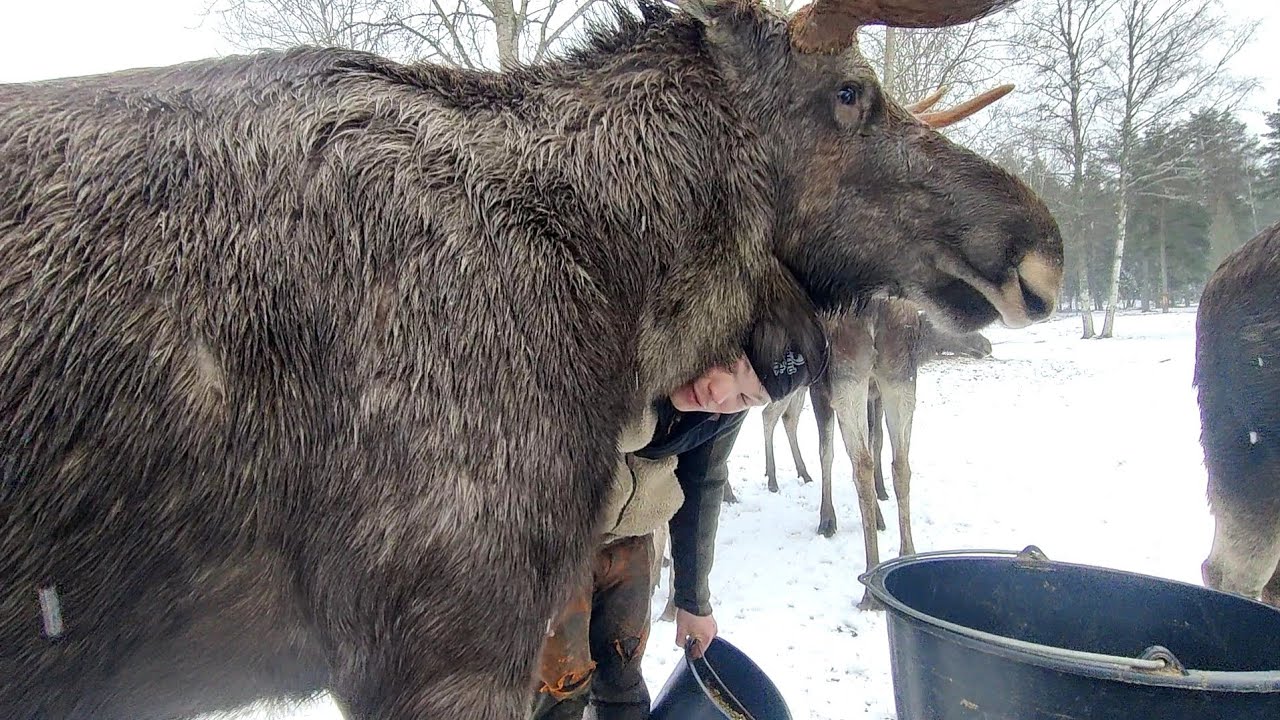
Keeper ducks under a bull moose at feeding time

A huge wet-coated bull moose with antlers stands in profile over a person in a dark beanie who bends beneath his throat holding a small bucket, with the slim legs of more moose behind them, a large black tub at lower right, and snow and bare trees beyond.

Footage: Skullaryd Älgpark · 2:45 · uploaded February 26, 2023
Written by My Crittercam · published November 6, 2026

The Story

To reach the bucket, a keeper ducks under the throat of a bull moose. The bull allows it, coat hanging in wet spikes, antlers still on his head, long muzzle pointed out over the snow.

This is feeding time at a moose park in Sweden, with bare trees behind and black buckets on the white ground. No deer species is less social than the moose, so a mixed group around the buckets is not the usual picture. The keeper knows these animals by name, age and family, and goes down the line making introductions.

The bulls come first, and they split the antler calendar between them. The six-year-old dropped his in January. The three-year-old beside him still has his, which the keeper puts down to youth. Minnesota DNR says antlers are usually shed in December and January. Bulls lose them after the rut to save energy for winter, and new ones start growing in April.

With a person in the frame for scale, a moose stops being a number on a field guide page. A large Alaska bull can reach 1,600 pounds, and a moose can eat up to 70 pounds of food a day. The calm here is one side of the animal. Moose usually flee, but more people in Alaska are injured by moose than by bears yearly, and they can turn aggressive when harassed or when hungry and tired in deep snow.

Then the young. One calf was born in May and has a twin sister, and twins are common in moose. A calf weighs about 28 pounds at birth and grows to about 10 times that within 5 months, so this one meets the snow already a big animal. Their big sister is here too, one year old, and the mother is the big cow on the other side.

Next year, the keeper says, the calf will look like her big sister, which leaves one more neck to duck under.
Field Guide

At a moose park in Sweden, a keeper feeding from buckets in the snow introduces two bulls, one with antlers and one without, a May-born calf, her yearling sister and their mother. Full field guide for the Moose

Common nameMoose
Scientific nameAlces alces
FamilyCervidae (Deer family)
SizeAdults stand on average 5 to 7 feet at the shoulder; total length about 9 feet (Maine).National Park Service · Maine Department of Inland Fisheries and Wildlife · Animal Diversity Web, University of Michigan
Weight800 lb (small adult female) to 1,600 lb (large adult male).Alaska Department of Fish and Game · Animal Diversity Web, University of Michigan
DietBrowser: leaves and shoots in summer, twigs of willow, birch and aspen in fall and winter, plus aquatic plants. Up to 70 lb of food a day.Animal Diversity Web, University of Michigan · Alaska Department of Fish and Game · National Park Service
Active whenCrepuscular: most active at dawn and dusk.Animal Diversity Web, University of Michigan · Maine Department of Inland Fisheries and Wildlife
LifespanRarely more than 16 years in the wild; one cow lived to 22.Alaska Department of Fish and Game · Animal Diversity Web, University of Michigan
Conservation statusIUCN Red List: Least Concern. NatureServe: G5; N5 in US and Canada.Animal Diversity Web, University of Michigan · NatureServe Explorer
Cam notes · Time of dayday
Cam notes · Seasonwinter, snow on the ground
Cam notes · PlaceSweden

Habitat

Behavior

Questions

Do moose drop their antlers every year?

Minnesota DNR says antlers are usually shed in December and January. Bulls regrow them each spring, starting in April.Minnesota Department of Natural Resources · National Park Service

Are moose really this calm around people?

Moose usually flee, yet more people in Alaska are injured by moose than by bears yearly. They can become aggressive when harassed, when hungry and tired in deep winter snow, or as cows guarding calves.Alaska Department of Fish and Game

Do bulls get dangerous during the rut?

Bulls can be extremely aggressive and dangerous during the rut. Breeding runs in late September and early October.Alaska Department of Fish and Game · National Park Service

Latest clips