The Story
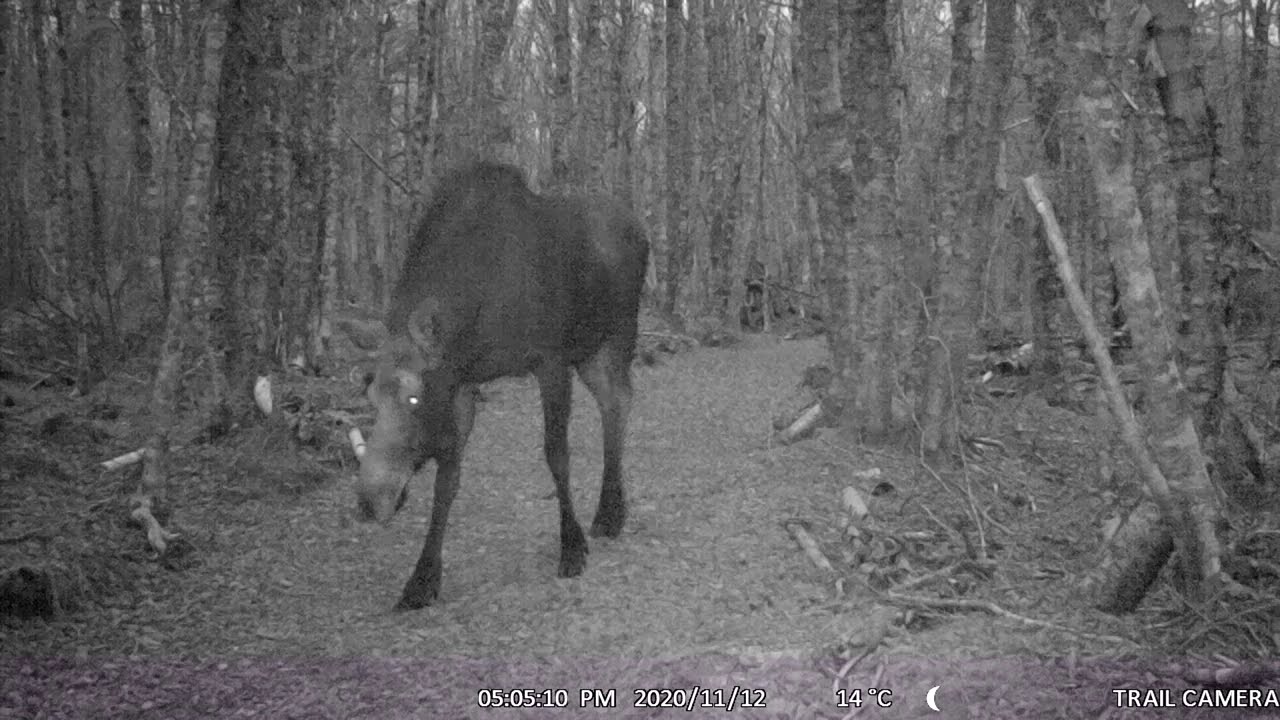
A moose stands mid-stride on a trail carpeted in fallen leaves, bare November woods around it, and puts its long nose to the ground. The trail camera has already gone to infrared at five past five in the afternoon.
Everything about the animal runs long. The legs rise tall above the litter, the drooping muzzle hangs near the ground, and the back peaks above the front shoulders. This is the largest member of the deer family: five to seven feet at the shoulder on average, and anywhere from 800 pounds for a small cow to 1,600 for a large bull.
The head is bare. Bulls drop their antlers after the rut, in late fall or early winter, and Minnesota DNR says usually in December and January, so an antlerless moose in mid-November leans toward a cow without proving it. A cow's brown face against a bull's black one would help, but infrared shows no color.
The hour fits. Moose are crepuscular, most active at dawn and dusk. Walking alone fits too: moose are the least social of the deer, fairly solitary outside the mating season, and the rut is weeks past.
The lowered head could be sniffing the trail or picking at the leaves; the frame does not say which. In fall, moose browse willow, birch and aspen twigs, and an adult needs about 20 kilograms of food a day. That is a great many twigs.
Each of the three moose clips plays twice, once at normal speed and once at half speed, and the slow pass is where those legs earn a second look. On a bare autumn trail they seem almost excessive. In deep snow they are the right tool, letting a moose paw down to its food. This one keeps its head low the whole frame.