My Crittercam
My Crittercam › Elk

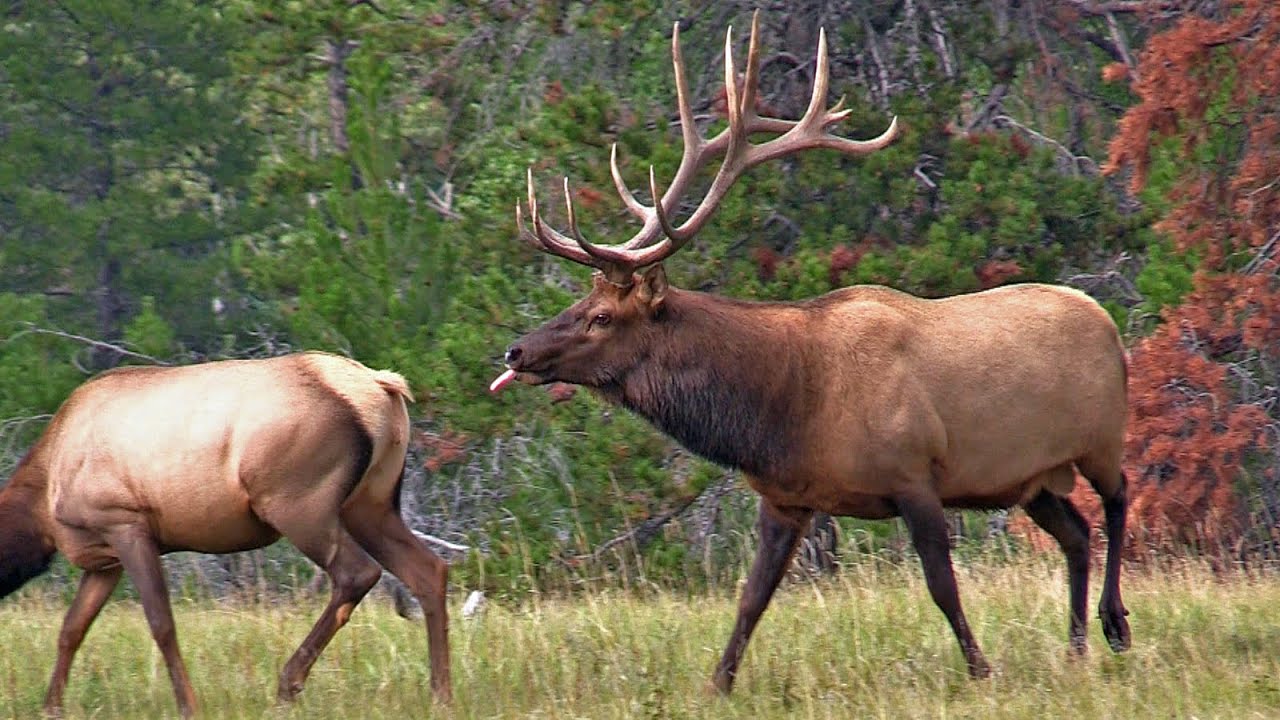
Rutting bull elk strides the meadow edge

A bull elk with a tall, many-tined rack and a dark shaggy mane walks left through tall grass in front of green conifers, his face at the left edge of the frame.

Footage: WildlifeOnVideo · 9:05 · uploaded December 13, 2020
Written by My Crittercam · published November 6, 2026

The Story

A bull elk crosses a meadow in the Canadian Rockies with his tongue flicking out of his mouth, close behind a cow who keeps walking. It is the rut, and he has a harem to hold.

His rack climbs well above his ears, bare of velvet, and a dark shaggy mane hangs from his neck to his chest, darker than his tan flanks. Antlers grow on bulls, very occasionally on cows, and a mature bull's generally run to six points a side. The other mark worth learning is the elk's buff rump patch, set against a brown body.

His aggression and herding drive are running very high, and he moves like it. He runs up on the cows, tongue working. They mostly drop their heads and go on grazing. None of them seems to share his sense of urgency.

Timing explains the hurry. The elk rut generally runs from early September to mid-October, and elk breed in late September and early October. A bull gathers anywhere from 3 or 4 cows to as many as 20 to 25, and in the rut he can weigh up to 1,100 pounds. Prime breeding bulls are eight to nine years old, in a species that lives 10 to 13 years in the wild.

At one point he turns on the ground itself, urinating and scraping his antlers through the dirt like a harrow. Bull antlers can grow up to an inch a day under velvet in spring and summer, and a mature bull's can weigh up to 40 pounds.

Elk are called the noisiest of all deer, and a rut bull's bugle is a guttural groan that climbs to a high whistle, made to advertise his status and draw cows. Behind this one, conifers run down to the grass, a forest broken by meadow, which is where elk do best.
Field Guide

In the Canadian Rockies rut, a bull elk runs up on his grazing cows with his tongue flicking, then urinates and rakes his antlers through the dirt. Full field guide for the Elk

Common nameElk
Scientific nameCervus canadensis
FamilyCervidae (Deer family)
SizeBulls about 5 feet at the shoulder and about 8 feet nose to tail; cows about 4 1/2 feet tall and about 6 feet long.National Park Service · Animal Diversity Web, University of Michigan
WeightLarge bulls can weigh 700-1000 pounds (up to 1,100 in the rut); cows around 300-500 pounds. Calves about 30 pounds at birth.National Park Service · National Park Service · Animal Diversity Web, University of Michigan
DietGrasses, sedges, forbs and shrubs (especially willow and serviceberry); in winter, shrubs, aspen bark and conifers. About 20 pounds of vegetation a day.Montana Natural Heritage Program and Montana Fish, Wildlife & Parks · National Park Service · National Park Service · Washington Department of Fish and Wildlife
Active whenFeeds in the early morning and late evening; rests and chews cud during the day and the middle of the night.Animal Diversity Web, University of Michigan
RangeWestern North America (Rocky Mountains to the Pacific coast and western Canada), with reintroduced herds in the East such as Great Smoky Mountains National Park.Animal Diversity Web, University of Michigan · Washington Department of Fish and Wildlife · National Park Service
Lifespan10-13 years in the wild; Yellowstone's northern range elk regularly live to about 18 years.National Park Service · National Park Service
Conservation statusIUCN Red List: Least Concern. NatureServe: G4 (Apparently Secure); N5 in Canada, N4 in the US.NatureServe Explorer
Cam notes · Time of dayday
Cam notes · Seasonduring the elk rut
Cam notes · Placethe Canadian Rockies

Habitat

Behavior

Questions

When is the elk rut?

The elk rut runs from early September to mid-October, with breeding peaking in late September and early October. Bulls bugle through it to advertise their status and attract cows.National Park Service · Montana Natural Heritage Program and Montana Fish, Wildlife & Parks · Washington Department of Fish and Wildlife · Animal Diversity Web, University of Michigan

How many cows can one bull elk keep in a harem?

Bulls gather harems that range from 3 or 4 cows to as many as 20 to 25. Prime breeding bulls are eight to nine years old.Washington Department of Fish and Wildlife · National Park Service

How big do a bull elk's antlers get?

A mature bull's antlers generally have five tines off the main branch, for six points a side. They can weigh up to 40 pounds.Montana Natural Heritage Program and Montana Fish, Wildlife & Parks · Rocky Mountain Elk Foundation · National Park Service · Washington Department of Fish and Wildlife · National Park Service

Latest clips