My Crittercam
My Crittercam › Moose

Six months of moose at a backcountry trail cam

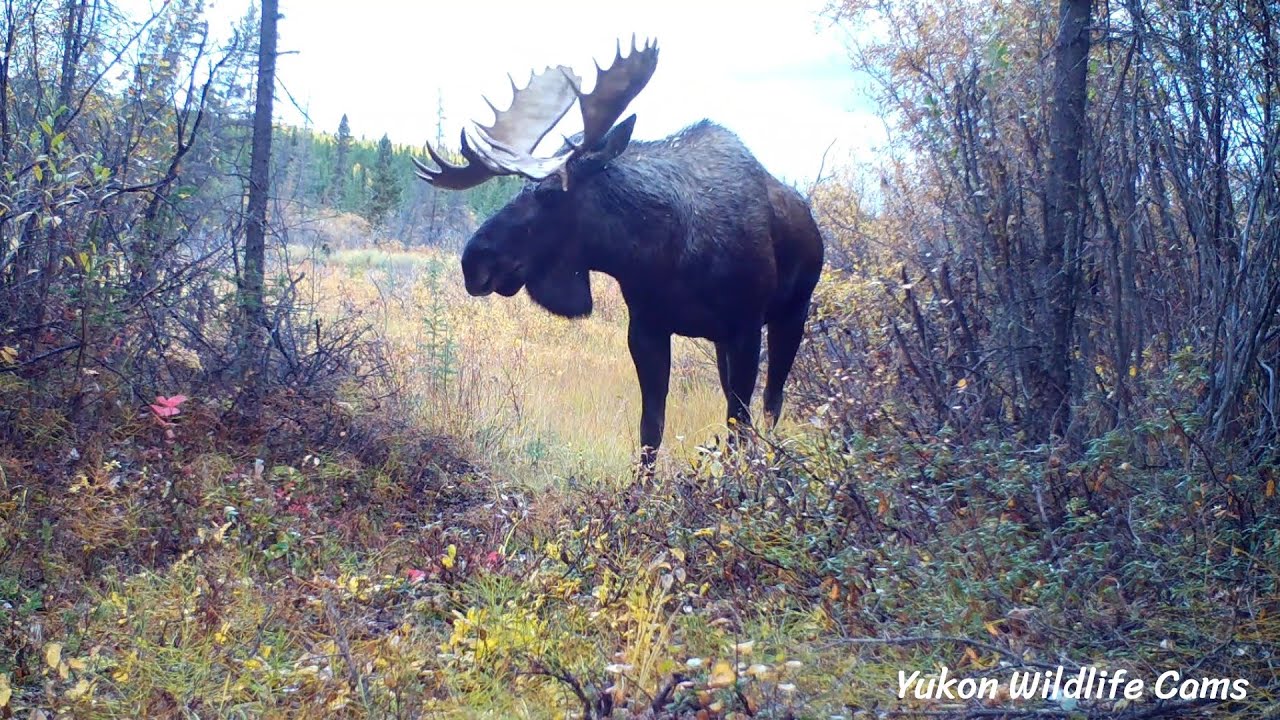
A dark bull moose with wide palmate antlers and a hanging bell stands at the edge of a yellowing meadow, facing left, his hindquarters cut off by the right edge, with yellow and red-leaved brush in the foreground and conifers under a pale sky behind.

Footage: Yukon Wildlife Cams · 5:54 · uploaded March 15, 2024
Written by My Crittercam · published November 6, 2026

The Story

A bull moose stands where the brush opens onto a meadow, palmate antlers spread against a pale sky, long muzzle lowered, the bell hanging under his throat. He is one visitor among six months of them.

The camera sits on a backcountry trail and ran from May through October 2023. Its owner calls it the Moose Cam, and the name is earned: moose come through often enough to claim the place. The rest of the cast is heavy too. Lynx turn up again and again, grizzlies and black bears pass, a few wolves walk the same line, and snowshoe hares hop through.

A calf shows up across the season, a little bigger at each pass. The calendar explains it. Calving runs from late May through early June, a newborn weighs about 28 pounds, and within five months it is about ten times that size. A calf stays with its mother for about a year, until she drives it off shortly before the next one arrives.

The bull's rack keeps its own schedule. Antlers start growing in April under velvet and can add as much as 8 inches in nine days. The velvet sheds in September as testosterone surges, and the rut runs from mid-September to mid-October, when bulls spar with those antlers. A camera running May to October spans nearly the whole build.

The trail that brings the moose also brings the animals that hunt them. Wolves, black bears and brown bears all prey on moose. Here the bears show a keen interest in something else entirely, the camera, which takes the brunt of their curiosity.

Food and cover decide where moose linger. Young, regenerating forest supplies shrubs and saplings for leaves in the growing season and twigs in winter, while standing timber gives summer shade for bedding. Moose are most active at dawn and dusk; this bull is out in plain daylight, a dark shape too big to miss.
Field Guide

Over six months on one backcountry trail, moose pass often enough to name the site, a calf grows visit by visit, and grizzlies, black bears, wolves and lynx share the path. Full field guide for the Moose

Common nameMoose
Scientific nameAlces alces
FamilyCervidae (Deer family)
SizeAdults stand on average 5 to 7 feet at the shoulder; total length about 9 feet (Maine).National Park Service · Maine Department of Inland Fisheries and Wildlife · Animal Diversity Web, University of Michigan
Weight800 lb (small adult female) to 1,600 lb (large adult male).Alaska Department of Fish and Game · Animal Diversity Web, University of Michigan
DietBrowser: leaves and shoots in summer, twigs of willow, birch and aspen in fall and winter, plus aquatic plants. Up to 70 lb of food a day.Animal Diversity Web, University of Michigan · Alaska Department of Fish and Game · National Park Service
Active whenCrepuscular: most active at dawn and dusk.Animal Diversity Web, University of Michigan · Maine Department of Inland Fisheries and Wildlife
RangeMuch of Alaska and Canada, the northern edge of the contiguous US, and south along the Rocky Mountains to Utah and Colorado.Animal Diversity Web, University of Michigan
LifespanRarely more than 16 years in the wild; one cow lived to 22.Alaska Department of Fish and Game · Animal Diversity Web, University of Michigan
Conservation statusIUCN Red List: Least Concern. NatureServe: G5; N5 in US and Canada.Animal Diversity Web, University of Michigan · NatureServe Explorer
Cam notes · Camerafixed camera at one backcountry site, the "Moose Cam"
Cam notes · Time of dayday (cover frame)
Cam notes · SeasonMay to October 2023
Cam notes · Placebackcountry

Habitat

Behavior

Questions

Is a moose related to a horse?

The moose belongs to the deer family, Cervidae, and is its largest member. A shoulder hump and a flap of skin under the throat, called a bell, help set it apart.Minnesota Department of Natural Resources

How big does a moose calf get by fall?

A calf weighs about 28 pounds at birth and grows to about 10 times that size within 5 months. Calves are born late May through early June and stay with their mother about a year.Alaska Department of Fish and Game · National Park Service · Maine Department of Inland Fisheries and Wildlife

Do bears and wolves kill moose?

Wolves, black bears and brown bears all prey on moose. In Maine, predation is low because the predators there are not capable of killing adults.Alaska Department of Fish and Game · Maine Department of Inland Fisheries and Wildlife

Latest clips