My Crittercam
My Crittercam › White-tailed deer

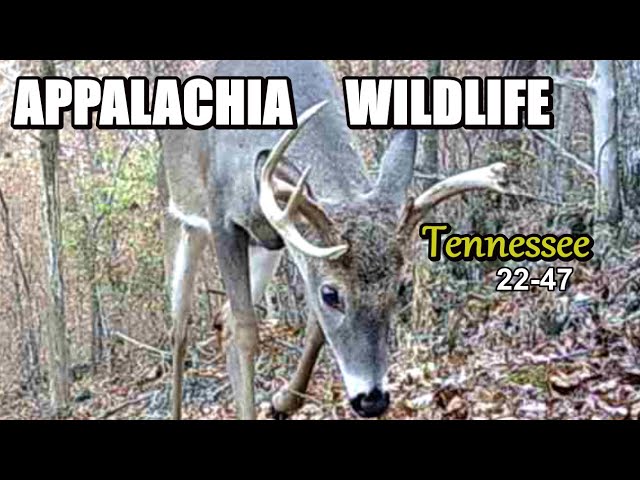
Tennessee whitetail buck, head low over leaves

A white-tailed buck with his head lowered toward the leaf litter, branching antlers curving above one white-ringed eye, a white band behind the black nose, a foreleg stepping forward, and burned-in title text across the top.

Footage: DONNIE LAWS Appalachia · 11:18 · uploaded November 21, 2022
Written by My Crittercam · published November 6, 2026

The Story

Only part of this white-tailed buck fits in the frame. His head hangs low over the fallen leaves, nose pointing down, one foreleg stepping forward, while the rest of him climbs out the top of the picture.

Hidden trail cameras in the East Tennessee foothills of the Smoky Mountains caught him in the week of November 14, 2022. The temperature has dropped from the 70s to the 30s since the filmer last came through, and his report on the deer is short: bucks of all sizes and all ages are turning up everywhere, and even the ones with good racks are trailing the does, unconcerned.

Daylight fits the season. Whitetails are typically most active around dawn and dusk, but activity may increase throughout the day during the breeding season. A doe in estrus is receptive for about 24 hours, a narrow target, and if she is not bred she comes into heat again every 28 days until early winter. Connecticut's mating peak falls in the last two weeks of November and Missouri's in mid-November. On this ridge the filmer calls the rut close.

Not every rack up here is whole. One buck has lost half his antlers. The filmer rates him a good six or eight and guesses he tried the ruling buck for dominance. That fight is his inference from the damage, and it fits the species: rival bucks clash antlers for access to a doe, and they do not guard harems.

Later comes a far bigger animal, a 10 or maybe a 12 point by the same count, the one he expects the others to avoid. Adult males carry spreading, branching antlers, and the head over these leaves has both sides in place. Which buck this is, the frame does not say.

There is also the yearling. With all that hustle going past, he wants to lie down and rest. Deer bed in dense cover or tall grasses and may return to the same spot over many days. He is, for now, a deer with no plans.
Field Guide

In the East Tennessee foothills in mid-November, a white-tailed buck holds his head low over the leaves at a hidden trail camera while bucks of every size trail the does. Full field guide for the White-tailed deer

Common nameWhite-tailed deer
Scientific nameOdocoileus virginianus
FamilyCervidae (Deer)
Active whenCrepuscular: typically most active around dawn and dusk; activity may increase throughout the day during the breeding season.Maine Department of Inland Fisheries and Wildlife
SizeHead and body 150 to 200 cm, tail 10 to 28 cm; 80 to 100 cm at the shoulder.Animal Diversity Web, University of Michigan
Weight57 to 137 kg (125.55 to 301.76 lb). Missouri: females 110-145 lb, males 155-195 lb.Animal Diversity Web, University of Michigan · Missouri Department of Conservation
DietHerbivore: leaves, twigs, fruits and nuts of trees and shrubs, herbaceous plants, grasses, crops, and occasionally fungi, mosses and lichens.Missouri Department of Conservation
RangeMost of southern Canada and the United States (except most of California, Nevada and Utah), south through Central America to Bolivia.Animal Diversity Web, University of Michigan · Connecticut Department of Energy & Environmental Protection
LifespanMost live about 2 to 3 years; maximum in the wild 20 years, but few live past 10.Animal Diversity Web, University of Michigan
Conservation statusIUCN Red List: Least Concern (via NatureServe Explorer); NatureServe global rank G5.NatureServe Explorer
Cam notes · Camerahidden trail cameras
Cam notes · Time of dayday
Cam notes · Seasonfall, week of November 14, 2022
Cam notes · PlaceEast Tennessee foothills of the Smoky Mountains

Habitat

Behavior

Questions

How do deer survive winter?

They grow an insulating coat of woolly underfur and erectable hollow guard hairs, and draw on fat stored in autumn to supplement poor winter browse. In much of Maine, softwood cover intercepts snow, lowering snow depth.Maine Department of Inland Fisheries and Wildlife · Maine Department of Inland Fisheries and Wildlife

Where do deer sleep?

Deer sleep in dense cover or tall grass and may return to the same spot over many days. In winter, beds show as depressions in the snow, often littered with old hair.Washington Department of Fish and Wildlife

When is the rut?

Breeding runs from about October to January, with peak activity in mid-November in New York, Maine and Missouri. Bucks rub trees, make scrapes and fight with their antlers.National Park Service · Maine Department of Inland Fisheries and Wildlife · Missouri Department of Conservation

Latest clips