My Crittercam
My Crittercam › Black-capped Chickadee

The two-tone whistle of a black-capped chickadee

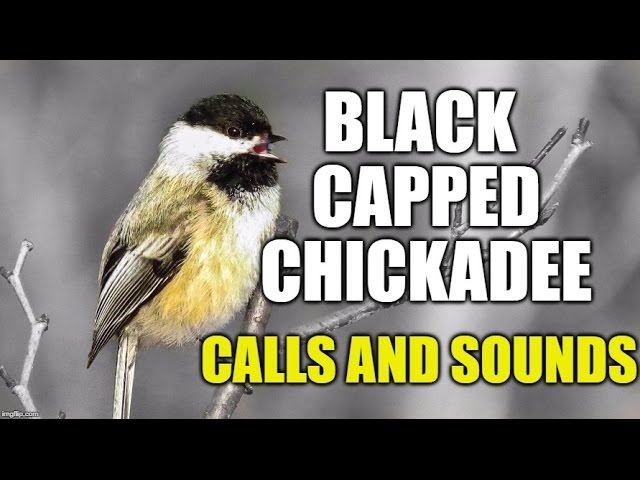
A black-capped chickadee with a black cap and bib, white cheek and buffy yellow flanks perches on a bare twig with its bill open, beside cropped white and yellow lettering.

Footage: Lesley the Bird Nerd · 1:11 · uploaded November 14, 2015
Written by My Crittercam · published November 6, 2026

The Story

About half a minute in, two clear whistled notes arrive, the second lower than the first. That is the fee-bee song of the black-capped chickadee, and it does a very different job from the chick-a-dee call.

The picture carries the field marks: black cap, black bib, white cheeks, a buff wash down the sides. The bird sits on a bare twig with its bill open against a soft gray blur. What the picture cannot settle is the sex. Males use the fee-bee, but male and female look identical.

The whistle is a property claim. Males use it to set up territories and attract mates, mostly in late winter and spring. Pairs typically form in fall and stay in the winter flock, then the flock breaks up in late winter and each pair defends 1.5 to 5.3 hectares. That is a lot of real estate to hold with two notes and a body of 0.3 to 0.5 ounces.

The species has far more to say than that. Adults make as many as 16 different calls. A sharp zeet goes up at the sight of a predator, and groups mob predators to scare them away. In the chick-a-dee call, more dee notes generally mean a greater threat, and experiments with 15 live predator species found that mobbing calls varied with predator size.

Chickadees are not the only ones paying attention. Other songbirds, especially passing migrants, tend to tag along to listen for chickadee feeding and alarm calls. Around the 56-second mark a different bird starts up in the background here. It goes unnamed, and nothing shows it is listening in.

One catch for anyone matching this whistle outdoors. The Carolina chickadee is almost identical and best told apart by range, and in the overlap zone each species can learn the wrong song. There, two clean notes can name the wrong bird.

Field Guide

A black-capped chickadee's calls, with the two-tone fee-bee whistle coming through clean about half a minute in. Full field guide for the Black-capped Chickadee

Common nameBlack-capped Chickadee
Scientific namePoecile atricapillus
FamilyParidae (Chickadees and Titmice)
SizeLength 5–6 in (12–15 cm); about the size of a sparrow.National Audubon Society (Guide to North American Birds) · National Park Service, Mississippi National River & Recreation Area
Weight0.3–0.5 oz (9–14 g).National Audubon Society (Guide to North American Birds)
RangeAlaska through the southern half of Canada, south to the upper two-thirds of the United States; mostly a permanent resident.Animal Diversity Web, University of Michigan · National Audubon Society (Guide to North American Birds)
Active whenDiurnal: active by day from first light, sleeping at night in thick branches or tree cavities.Smithsonian's National Zoo and Conservation Biology Institute
DietMostly insects, seeds and berries; seeds and fruit may be no more than 10 percent of the summer diet and up to 50 percent in winter.National Audubon Society (Guide to North American Birds)
Wingspan6–8 in (15–20 cm).National Audubon Society (Guide to North American Birds)
LifespanEstimated average about 2.5 years; most live about two to three years. Oldest on record 12.5 years (ADW) or over 11.5 years (Smithsonian).Animal Diversity Web, University of Michigan · Smithsonian's National Zoo and Conservation Biology Institute
Conservation statusIUCN Red List: Least Concern; NatureServe global rank G5. Numbers apparently stable.NatureServe Explorer · National Audubon Society (Guide to North American Birds)
Cam notes · Time of dayday

Habitat

Behavior

Questions

What bird makes that two-tone whistle?

The whistled fee-bee, with its second note lower, is the song of the black-capped chickadee. Males use it to set up territories and attract mates, mostly in late winter and spring.National Audubon Society (Guide to North American Birds) · Animal Diversity Web, University of Michigan · Minnesota Department of Natural Resources (Minnesota Conservation Volunteer)

What is the purpose of each chickadee call?

Adults make as many as 16 different calls. The fee-bee is for territory and mates, the sharp zeet follows the sight of a predator, and more dee notes in the chick-a-dee call generally mean a greater threat.National Audubon Society (Guide to North American Birds) · Animal Diversity Web, University of Michigan · Smithsonian's National Zoo and Conservation Biology Institute · Minnesota Department of Natural Resources (Minnesota Conservation Volunteer)

Why do I hear this bird all year round?

It is mostly a permanent resident, making at most short-distance moves within the same general region. The whistled song itself comes mostly in late winter and spring, when males set up territories.National Audubon Society (Guide to North American Birds) · Animal Diversity Web, University of Michigan · Minnesota Department of Natural Resources (Minnesota Conservation Volunteer)

Latest clips