Black-capped Chickadee field guide
Field Guide
| Common name | Black-capped Chickadee |
|---|---|
| Scientific name | Poecile atricapillus |
| Family | Paridae (Chickadees and Titmice) |
| Size | Length 5–6 in (12–15 cm); about the size of a sparrow.National Audubon Society (Guide to North American Birds) · National Park Service, Mississippi National River & Recreation Area |
| Weight | 0.3–0.5 oz (9–14 g).National Audubon Society (Guide to North American Birds) |
| Wingspan | 6–8 in (15–20 cm).National Audubon Society (Guide to North American Birds) |
| Lifespan | Estimated average about 2.5 years; most live about two to three years. Oldest on record 12.5 years (ADW) or over 11.5 years (Smithsonian).Animal Diversity Web, University of Michigan · Smithsonian's National Zoo and Conservation Biology Institute |
| Diet | Mostly insects, seeds and berries; seeds and fruit may be no more than 10 percent of the summer diet and up to 50 percent in winter.National Audubon Society (Guide to North American Birds) |
| Active when | Diurnal: active by day from first light, sleeping at night in thick branches or tree cavities.Smithsonian's National Zoo and Conservation Biology Institute |
| Range | Alaska through the southern half of Canada, south to the upper two-thirds of the United States; mostly a permanent resident.Animal Diversity Web, University of Michigan · National Audubon Society (Guide to North American Birds) |
| Conservation status | IUCN Red List: Least Concern; NatureServe global rank G5. Numbers apparently stable.NatureServe Explorer · National Audubon Society (Guide to North American Birds) |
Field Marks
- Black cap and black bib with white cheeks; gray back and wings; buffy undersides fading to white on the chest.Smithsonian's National Zoo and Conservation Biology Institute
- Buff wash on the sides; light-rufous flanks, brighter in young birds.National Audubon Society (Guide to North American Birds) · Animal Diversity Web, University of Michigan
- Short plump body, long tail and tiny, pointed black beak; shape identifies it even at a distance.Minnesota Department of Natural Resources (Minnesota Conservation Volunteer) · Animal Diversity Web, University of Michigan
- Male and female look identical.Animal Diversity Web, University of Michigan
- Almost identical to the Carolina Chickadee and best told apart by range; in the overlap zone song may not help, as each species can learn the wrong song.National Audubon Society (Guide to North American Birds)
Habitat
- Mixed and deciduous woods, willow thickets, groves and shade trees; most common in open woods and forest edge, especially with birches or alders.National Audubon Society (Guide to North American Birds)
- Avoids purely coniferous forest, but in harsh winter weather small flocks are sometimes seen in dense pine forests.National Audubon Society (Guide to North American Birds) · Smithsonian's National Zoo and Conservation Biology Institute
- Will live in suburbs as long as nest sites are available, and is a frequent visitor to backyard feeders.National Audubon Society (Guide to North American Birds) · Animal Diversity Web, University of Michigan
- Nests in a tree hole usually 5–20 ft above the ground, typically an enlarged natural cavity in rotten wood, sometimes an old woodpecker hole or a nest box.National Audubon Society (Guide to North American Birds)
- Prefers nest trees with soft heartwood but sturdy outer wood; pairs often excavate several cavities before the female picks one.Animal Diversity Web, University of Michigan
Behavior
- Forages mostly by hopping among twigs and gleaning, often hanging upside down to reach the underside of branches; sometimes hovers or catches insects in mid-air.National Audubon Society (Guide to North American Birds)
- At feeders it may take sunflower seeds one at a time and fly away to stuff them into bark crevices.National Audubon Society (Guide to North American Birds)
- At feeders it tests each sunflower seed for plumpness and discards empty shells before opening them, to get the most calories for the least effort.National Park Service, Mississippi National River & Recreation Area
- Among the easiest birds to feed by hand; a person must stand very still and let the birds get used to them.National Park Service, Mississippi National River & Recreation Area
- Likes to live in flocks of up to 12 birds. Other songbirds, especially passing migrants, tend to tag along to listen for chickadee feeding and alarm calls.Smithsonian's National Zoo and Conservation Biology Institute
- Non-breeding flocks are often mixed, with nuthatches, woodpeckers, kinglets, brown creepers, warblers and vireos.Animal Diversity Web, University of Michigan
- Flocks have dominance hierarchies; males outrank females, and the highest-ranking males and females usually pair together.Animal Diversity Web, University of Michigan · Smithsonian's National Zoo and Conservation Biology Institute
- Subordinate birds tend to forage in the outermost parts of trees, where they are most exposed to predators.Smithsonian's National Zoo and Conservation Biology Institute
- Adults make as many as 16 different calls. The more 'dees' at the end of the chick-a-dee call, generally the greater the threat a predator poses.Smithsonian's National Zoo and Conservation Biology Institute
- In experiments with 15 live predator species, mobbing-call features varied with predator size, and mobbing intensity was related to the predator's size and threat.Science / PubMed
- Gives a sharp 'zeet' alarm call on seeing a predator, and groups mob predators to scare them away. Adults are preyed on mainly by small hawks, owls and shrikes.Animal Diversity Web, University of Michigan
- The whistled 'fee-bee' song, second note lower, is used by males to set up territories and attract mates, mostly in late winter and spring.National Audubon Society (Guide to North American Birds) · Animal Diversity Web, University of Michigan · Minnesota Department of Natural Resources (Minnesota Conservation Volunteer)
- Pairs typically form in fall and stay in the winter flock; flocks break up in late winter and pairs defend breeding territories of 1.5 to 5.3 ha.National Audubon Society (Guide to North American Birds) · Animal Diversity Web, University of Michigan
- Lays usually 6–8 eggs between April and early July, depending on region; female incubates 12–13 days and young leave the nest at about 16 days.National Audubon Society (Guide to North American Birds) · Animal Diversity Web, University of Michigan
Winter
- Body temperature drops at night to save energy. NPS: on cold winter nights, from a normal 108 degrees to 86 degrees. Smithsonian: on the coldest nights, from 107.6 °F to 82 °F.National Park Service, Mississippi National River & Recreation Area · Smithsonian's National Zoo and Conservation Biology Institute
- In fall a chickadee can store up to 1,000 seeds a day or 80,000 a season, hiding food in bark crevices and small cavities.Smithsonian's National Zoo and Conservation Biology Institute · Minnesota Department of Natural Resources (Minnesota Conservation Volunteer)
- New neurons are added to the hippocampus, the brain's spatial-memory area, all year but peak in October in wild birds; fall hippocampus volume grows through added cells.PNAS / PubMed · Journal of Neurobiology / PubMed
- Stays warm through insulation, activity and remembered food stores: it can hold a 100 °F body temperature even when the air is 0 degrees, and eats more than 35 percent of its weight daily.U.S. Fish and Wildlife Service
Questions
How big is a chickadee?
It is 5–6 inches (12–15 cm) long and weighs 0.3–0.5 oz (9–14 g). That is about the size of a sparrow.National Audubon Society (Guide to North American Birds)
What does a chickadee eat?
In summer mostly caterpillars, other insects and spiders, plus berries. In winter it eats insect eggs and pupae, seeds and berries, and it will eat fat from dead animals.National Audubon Society (Guide to North American Birds)
What does the chick-a-dee call mean?
It is a complex call with information encoded in each note; generally the more 'dee' notes, the greater the threat a predator poses. In experiments, chickadee mobbing calls varied with predator size.Smithsonian's National Zoo and Conservation Biology Institute · Science / PubMed
Where does a chickadee sleep in winter?
In thick branches, dense pine boughs or tree cavities, with its beak tucked under its wing. It usually sleeps alone but sometimes clumps with others for warmth.Smithsonian's National Zoo and Conservation Biology Institute · National Park Service, Mississippi National River & Recreation Area
How does such a small bird survive freezing nights?
On cold nights it lowers its body temperature to save energy (NPS: from 108 to 86 degrees) and makes heat by shivering. It roosts in sheltered spots and draws on food it cached in bark crevices and small cavities.National Park Service, Mississippi National River & Recreation Area · Minnesota Department of Natural Resources (Minnesota Conservation Volunteer)
How does it remember where it hid its seeds?
Its hippocampus, the spatial-memory part of the brain, adds new neurons with a peak in fall. Hippocampus size is larger in chickadees from colder, harsher places.PNAS / PubMed · Smithsonian's National Zoo and Conservation Biology Institute
Why does it take one seed and fly away?
At feeders it may carry sunflower seeds off one at a time to stuff into bark crevices, and it often stores food to recover later. It also tests seeds and discards empty ones unopened.National Audubon Society (Guide to North American Birds) · National Park Service, Mississippi National River & Recreation Area
Do chickadees migrate?
Mostly no: it is mostly a permanent resident, making at most short-distance moves within the same general region. Occasional fall 'invasions' send large numbers south, mostly in the northeastern states and southeastern Canada.National Audubon Society (Guide to North American Birds) · Animal Diversity Web, University of Michigan
Are chickadees harmful to people?
No negative effects on humans are known. They help control insects that can harm agriculture and forestry.Animal Diversity Web, University of Michigan
Are male and female chickadees different?
No, the sexes look identical. Males outrank females in the flock, and the male brings food to the female while she incubates.Animal Diversity Web, University of Michigan · National Audubon Society (Guide to North American Birds)
Clips
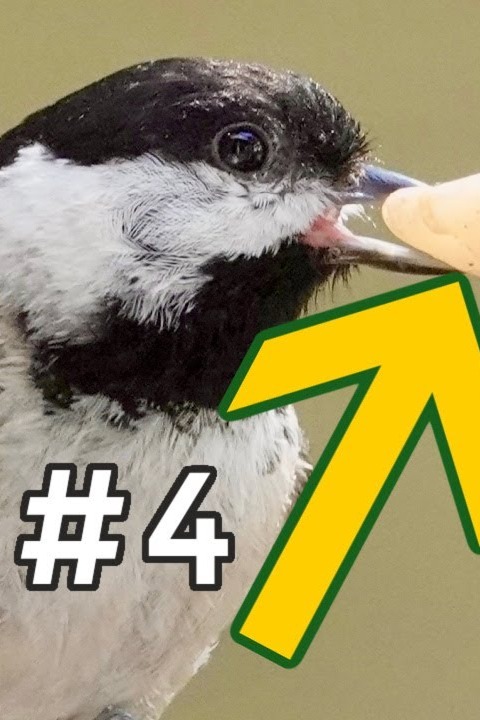 Shelled peanut in a black-capped chickadee's bill
 Head tipped low, a chickadee eyes the camera
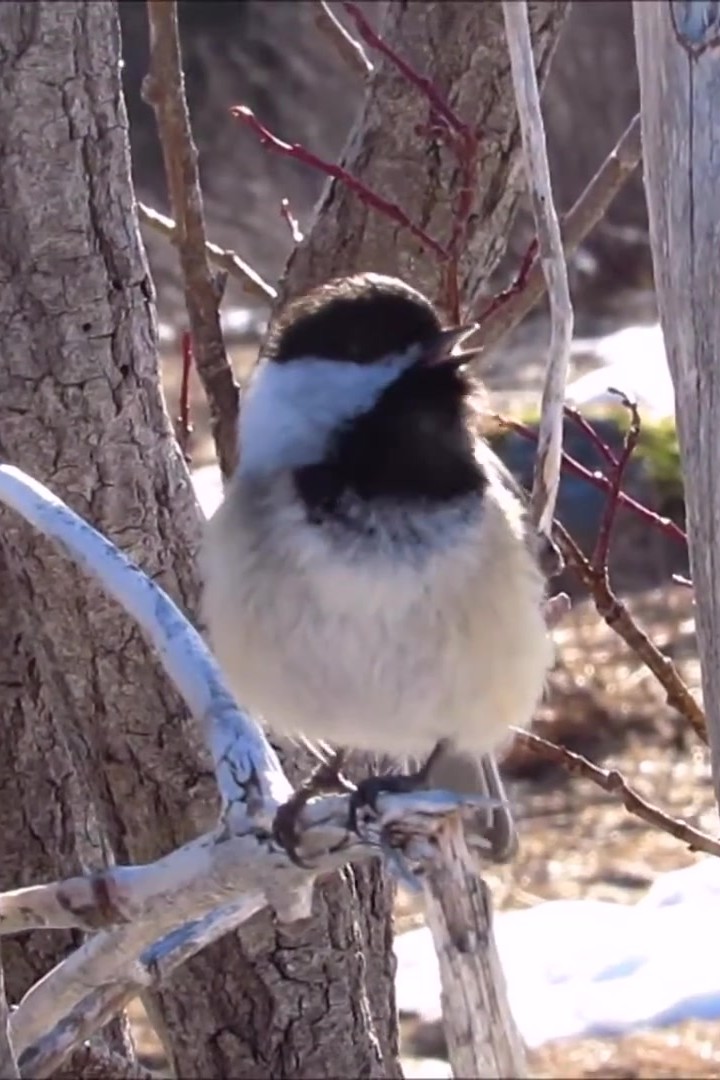 The two-tone whistle of a black-capped chickadee
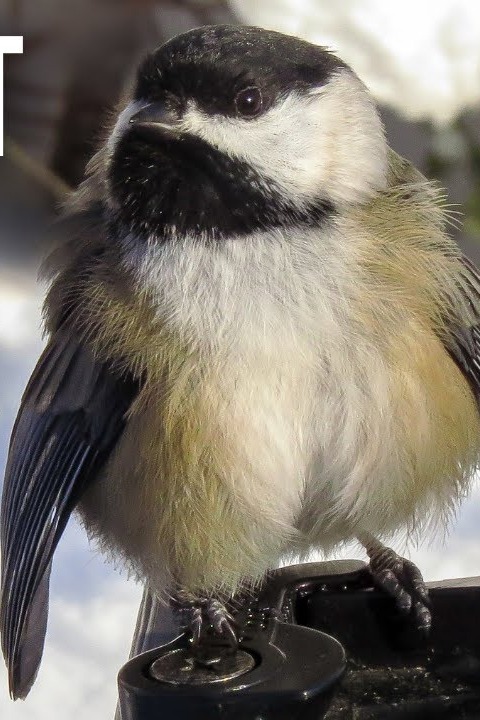 Black-capped chickadee puffs up, wings held out
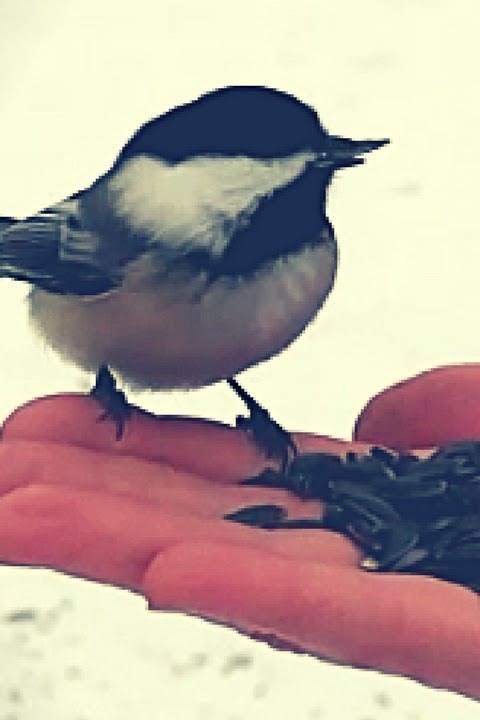 Black-capped chickadee on a palm full of seeds
Number four of eight backyard feeder foods, a shelled peanut pinched in the tip of a black-capped chickadee's bill.
A close-up of a black-capped chickadee, head tipped low over snow, fronts a countdown of five feats that runs from upside-down feeding to cold-night temperature drops.
A black-capped chickadee's calls, with the two-tone fee-bee whistle coming through clean about half a minute in.
A black-capped chickadee on a snowy backyard perch raises its breast feathers and holds its wings out in a slowed-down body ruffling display given when another chickadee is close.
On a snowy winter hike, black-capped chickadees take turns landing on a bare, seed-heaped palm and carry their seeds off to nearby branches.
Sources
- Black-capped Chickadee, National Audubon Society (Guide to North American Birds)
- Poecile atricapillus (black-capped chickadee), Animal Diversity Web, University of Michigan
- Black-capped chickadee, Smithsonian's National Zoo and Conservation Biology Institute
- Black-capped Chickadee (Paru atricapillus), National Park Service, Mississippi National River & Recreation Area
- Minnesota Profile: Black-capped Chickadee (Poecile atricapillus), Minnesota Department of Natural Resources (Minnesota Conservation Volunteer)
- How do birds keep warm in the winter?, U.S. Fish and Wildlife Service
- Poecile atricapillus, NatureServe Explorer
- Allometry of alarm calls: black-capped chickadees encode information about predator size (Templeton, Greene, Davis 2005, Science 308:1934-7), Science / PubMed
- Seasonal recruitment of hippocampal neurons in adult free-ranging black-capped chickadees (Barnea, Nottebohm 1994, PNAS 91:11217-21), PNAS / PubMed
- Seasonal changes in neuron numbers in the hippocampal formation of a food-hoarding bird: the black-capped chickadee (Smulders et al. 2000, J Neurobiol 44:414-22), Journal of Neurobiology / PubMed