My Crittercam
My Crittercam › Moose

Two moose get talked out of a doorstep pumpkin

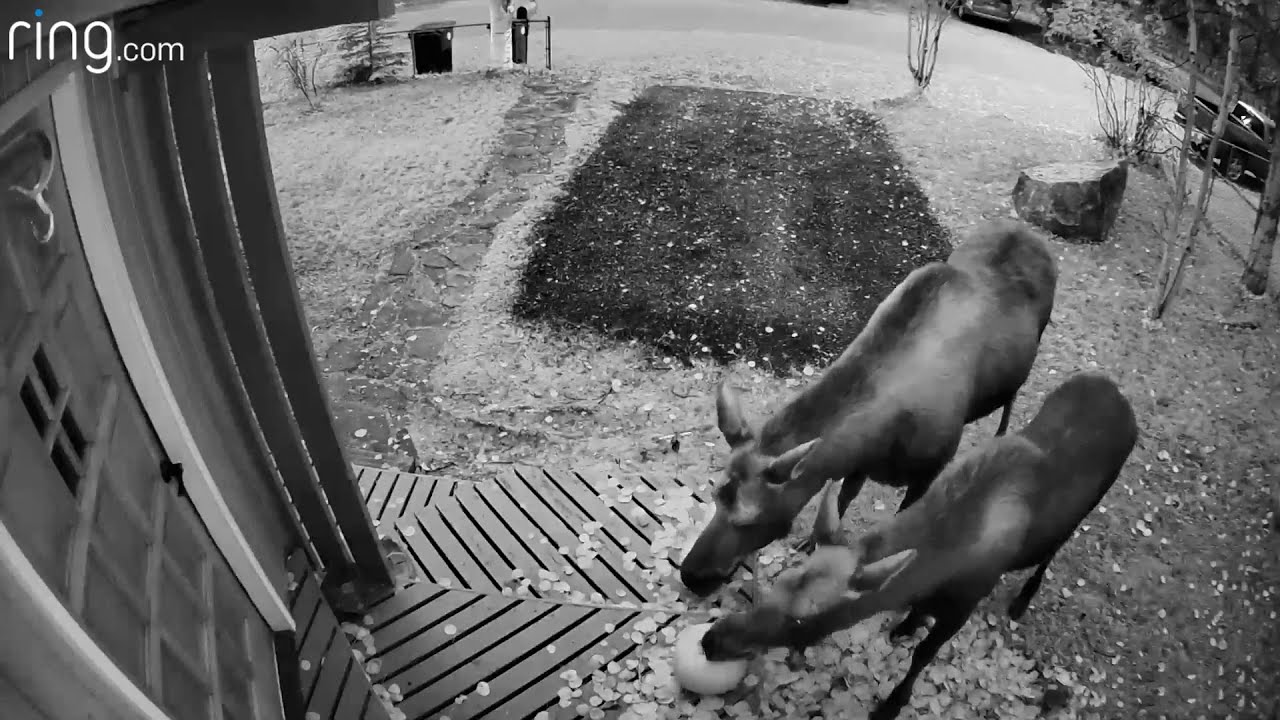
In black and white, two moose stand side by side with heads lowered, one muzzle on a pale pumpkin on leaf-strewn ground, a tree stump and a paved drive behind them.

Footage: Ring · 0:30 · uploaded November 29, 2021
Written by My Crittercam · published November 6, 2026

The Story

Two moose have their heads down at the door, one muzzle on a pale pumpkin, and the woman who owns that pumpkin is out at the grocery store.

She is not missing a thing. Her security camera has already sent an alert to her phone, and she is seeing the pair in real time from the store. They stand close together in the fallen leaves, long drooping muzzles at her decorations. Neither carries antlers in this frame.

A pair is worth noticing. The moose is the least social of the deer, fairly solitary except during the mating season. Calves, though, stay with the mother for about a year, and at least one of these two looks young. A cow and her calf would explain two animals at one pumpkin, but nothing here confirms that this is who they are.

The menu stands out too. A moose is a browser that can eat up to 70 pounds of food a day. Its fall and winter food is large quantities of willow, birch and aspen twigs. A pumpkin is not on that list, and these two are eating it anyway.

So she talks to them. From the store, through the camera, she asks the two moose to stop. As arguments with this animal go, it is held at a very good distance. Adults run from 800 pounds for a small cow to 1,600 for a large bull, and more people in Alaska are injured by moose than by bears each year. Moose usually flee when threatened, but they can turn aggressive when harassed, and a cow guarding a calf can too.

What two moose make of a voice with no person behind it, nobody can say. The result surprises her as much as anyone. They listen, the eating stops, and she has done it all from the store.
Field Guide

Two moose bend to a pumpkin at a house door until its owner, out at the grocery store, speaks to them through her security camera and they stop. Full field guide for the Moose

Common nameMoose
Scientific nameAlces alces
FamilyCervidae (Deer family)
DietBrowser: leaves and shoots in summer, twigs of willow, birch and aspen in fall and winter, plus aquatic plants. Up to 70 lb of food a day.Animal Diversity Web, University of Michigan · Alaska Department of Fish and Game · National Park Service
Weight800 lb (small adult female) to 1,600 lb (large adult male).Alaska Department of Fish and Game · Animal Diversity Web, University of Michigan
SizeAdults stand on average 5 to 7 feet at the shoulder; total length about 9 feet (Maine).National Park Service · Maine Department of Inland Fisheries and Wildlife · Animal Diversity Web, University of Michigan
Active whenCrepuscular: most active at dawn and dusk.Animal Diversity Web, University of Michigan · Maine Department of Inland Fisheries and Wildlife
RangeMuch of Alaska and Canada, the northern edge of the contiguous US, and south along the Rocky Mountains to Utah and Colorado.Animal Diversity Web, University of Michigan
LifespanRarely more than 16 years in the wild; one cow lived to 22.Alaska Department of Fish and Game · Animal Diversity Web, University of Michigan
Conservation statusIUCN Red List: Least Concern. NatureServe: G5; N5 in US and Canada.Animal Diversity Web, University of Michigan · NatureServe Explorer
Cam notes · Camerahome security camera with two-way talk
Cam notes · Seasonfall, pumpkins out and leaves down

Habitat

Behavior

Questions

What do moose eat in the fall?

Large quantities of willow, birch and aspen twigs. Moose can take in up to 70 pounds of food a day.Alaska Department of Fish and Game · National Park Service

Is it safe to have moose in your yard?

Moose usually flee when threatened, yet more people in Alaska are injured by moose than by bears yearly. They can become aggressive when harassed, when hungry and tired in deep winter snow, or as cows guarding calves.Alaska Department of Fish and Game

Why would two moose be together?

The moose is the least social deer species and is fairly solitary except during the mating season. Calves stay with the mother about a year and are driven off shortly before the next calf is born.Animal Diversity Web, University of Michigan · Maine Department of Inland Fisheries and Wildlife

Latest clips